


six capital REPORT
overview
Clover appreciates that strategy, risk, governance, performance and sustainability are inseparable. While the report has been structured to incorporate both the requirements (Regulation 43) of the Companies Act 71 of 2008 as well as the King Report on Governance in South Africa 2009 ("King III"), Clover has also adopted the latest Integrated Reporting Framework as issued by the International Integrated Reporting Council ("IIRC") in 2013.
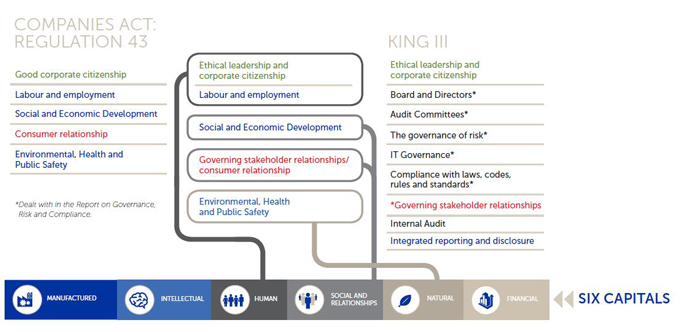
This framework follows a principle based approach in which Clover describes the key components of its business model it applied to create and sustain value for its stakeholders. This report is structured in accordance with the concept of the six capitals which takes into consideration the material inputs or resources required to create and preserve value since the company’s incorporation. The requirements of both Regulation 43 and King III are incorporated into the six capitals as diagrammatically depicted below:
Scope and Boundary
The scope of this report covers Clover’s South African operations and will over time be extended to its subsidiaries in other countries. The report also deals with the most relevant and material issues that could substantially impact on Clover’s ability to create and sustain value for its stakeholders going forward. Clover is one of a few South African businesses that have been in existence for well over 100 years, and we recognise that in order to survive and prosper, we need to be concerned with sustainability.
The Social and Ethics committee is chaired by the Lead Independent Director of the Board and consists of a further two Independent Directors and one Executive Director. Details of the members of the Social and Ethics Committee and the number of meetings (including the attendance of the members) held for the financial year are set here in the Report on Governance, Risk and Compliance.
The Social and Ethics Committee has considered the matters of the Integrated Annual Report that are pertinent to Clover. The responsibilities and functioning of the Social and Ethics Committee (“Committee”) are governed by formal terms of reference approved by the Board and is subject to regular review. The main objective of the Committee is to assist the Board in ensuring that Clover remains a responsible corporate citizen with sustainable business practices by monitoring, developing, reviewing and enhancing the Group’s social, ethical, environmental impact and governance in terms of Regulation 43 of the Act, and King III.
To accomplish these above-mentioned tasks, the Social and Ethics Committee has developed and adopted a formal work plan entailing the functions as set out in Regulation 43 of the Companies Act and King III. The implementation of this work plan is prioritised to enable Clover to fully discharge its statutory functions over a period of three years. The Board supports the Committee by setting the appropriate tone at the top, and Clover’s Way Better philosophy across the organisation contributes to Clover’s ethical culture. This report describes the work and conclusions of the Committee in its third year of establishment. Over and above the requirements of the Act, the scope of the report has also taken into consideration the guidelines to the Integrated Reporting Framework and the fourth edition of the Sustainability Reporting Guidelines of the Global Reporting Initiative. In short, through the six capitals, the key aspects of Clover’s business that are critical to its long-term value creation are summarised hereafter.
Annually, Clover defines its risk bearing capacity and risk appetite, being the basis of setting materiality levels. These materiality levels are used to annually adjust thresholds of Clover’s delegation of authority, ensuring that appropriate limits of managerial approval are set. These same materiality levels are used in Clover’s Enterprise Wide Risk Management Framework, which ultimately ensures that all material risks are reported to the Board Committees and considered for inclusion in Clover’s Integrated Annual Report.
For purposes of compiling this Integrated Annual Report, Clover is only reporting on issues it believes to be material.
 MANUFACTURED CAPITAL
Supply Chain Planning and Procurement
Clover’s Supply Chain Planning Department continuously assesses what required production levels should be by taking into consideration the market demand as received from Clover’s Marketing Department. These are then aligned to the availability of resources which, in the case of dairy products, is the seasonally available milk supply forecast as determined by Clover’s Milk Procurement Department. The output of this comparison is considered against Clover’s stock levels before the Planning Department updates the production schedules on a daily/weekly basis. The Planning Department is also responsible for the replenishment of all Clover’s Distribution Centres to ensure that there is adequate stock of the correct SKUs available to meet Clover’s customer’s demands. Furthermore, they are also responsible for all primary transport as well as raw milk deployment planning.
Clover has a centralised Procurement department responsible to procure ingredients and packaging materials from carefully selected suppliers who are contracted to ensure that consistent and high quality materials are used in the manufacturing process. Clover’s procurement philosophy is to build partnerships that shift the understanding beyond just monetary considerations. It encompasses socio-economic objectives and long-term value creation.
Milk Procurement
For the manufacture of dairy products, Clover procures milk from producers, who are contracted to ensure consistent supply and good quality milk, in order to meet market demand. Clover has developed a policy whereby 55 tests are conducted from farm to shelf to ensure that only the best quality and safe milk products are released for human consumption. To further guarantee the best possible quality raw milk, all our milk producers participate in Clover’s Best Farming Practices programme, whereby the quality of raw milk is continuously improved at farm level. Almost 100% of Clover’s raw milk is presently sourced from farms that have passed the Best Farming Practices audits with 80% or better.
Sustainable milk supply
Clover is one of few large dairy processors who have a longstanding history of purchasing raw milk from producers including previously disadvantaged producers. Economic factors and sustainable milk quality are the largest barriers of entry for these farmers. Likewise, a number of Black Economic Empowerment (“BEE”) initiatives have failed due to a lack in expertise, support and dedication at farm level. There are, however a number of very good examples of commercial producers partnering with communities and previously disadvantaged producers. Most of these projects were initiated by Amadlelo Agri (www.amadlelo.co.za) and have proved to be sustainable. Clover has made a meaningful contribution towards the implementation of some of these projects, not only by purchasing the milk, but also by subsidising the transport of this milk for quite some time.
Sustainable supply is ensured through Clover’s Unique Milk Procurement System ("CUMPS") and the Company pays a market related price for raw milk. The downward trend in the Group’s milk producer numbers is a result of continuous consolidation in the primary industry and is not a threat to the sustainability of milk supply in the short to medium term, but does have an impact on job creation, as bigger producers tend to mechanise more. It is therefore very important for the industry and government to find a way of ensuring a viable agricultural sector and dairy industry.
| Description | 2014 | 2013 | 2012 | 2011 | 2010 | 2009 |
| Litres of milk procured (million litres) | 632,3 | 667,7 | 648,2 | 652,4 | 608,2 | 638,7 |
| Litres of raw milk transported per kilometre | 98,97 | 70,3 | 69,0 | 73,4 | 80,0 | 88,0 |
| Number of milk producers who supplied milk to Clover during the year | 218 | 240 | 258 | 293 | 309 | 353 |
| Estimated number of employees employed by above producers* | 3 277 | 3 637 | 3 738 | 4 102 | 4 326 |
|
| Estimated number of dependants reliant on income received from above employees* | 13 867 | 13 656 | 18 690 | 20 510 | 21 630 | 24 710 |
| Producer selection | Clover sources its milk from 204 carefully selected collection points |
| Ongoing quality assurance | 55 quality checks are performed on fresh milk from when it is collected at the farm to when it reaches the shelf. |
| Clover Way Better approach to work | Clover’s production systems are flushed every eight hours to ensure freshness |
| Clover Way Better supply chain and warehousing capabilities | Delivering to 14 913 points through 583 trucks to an average of eight customers per day per truck |
Product responsibility over raw milk intake
Clover’s commitment to quality starts on the farms of its producers. In terms of Clover’s Best Farming Practices (“BFP”) programme, based on the International Dairy Federation’s directive, the following aspects are focused on:
- Animal health and herd management;
- Animal feed and water;
- Animal medication and agricultural chemicals;
- Milk hygiene and safety;
- Environmental management;
- Personnel and people;
- Treatment and hygiene registers; and
- Required registers and records.
As a market driven company, Clover pays careful attention to the needs of the consumers and one of the strong elements that came to the fore, is the fact that the consumers want natural milk products, free from artificial hormones and inhibitors. Clover has, therefore asked its producers to sign a declaration that they will not supply Clover with milk that originated from cows that were treated with recombinant bovine somatotropin ("rBST") and each and every Clover producer has signed such a declaration. Every tanker load of milk is furthermore tested for inhibitors like antibiotics and milk that has tested positive for inhibitors is coloured with a food colorant and discarded under controlled circumstances. This is further testimony that Clover will leave no stone unturned to ensure that Clover’s products are safe and nutritious.
Since June 2009, all of Clover’s milk producers have participated in the BFP programme. Compliance is assured through regular audits and producers representing nearly 100% of Clover’s raw milk intake have passed the audits, as already mentioned. Clover is still working on the integration of the above mentioned BFP programme into a much broader Clover Sustainable Dairy Model (“CSDM”). Given the complex and evolving nature of the programme, Clover intends phasing in the implementation over a number of years and this might include the use of consultants to ensure continuous improvement, through sharing in world-wide research and development programmes. Clover has in the meanwhile signed up as a member of the so-called Dairy Sustainability Framework ("DSF"), which forms part of the Global Dairy Agenda for Action ("GDAA").
The preliminary focus areas of this integrated programme are:
- Herd management, including managing of greenhouse gas (“GHG”) emissions;
- Animal feed, pasture and soil management, including GHG emissions and retention;
- Water management and treatment;
- Animal medication and agricultural chemicals;
- Dairy parlour and equipment (including infrastructure, hygiene and safety);
- Milk composition and quality;
- Environmental management, manure handling and bio-diversity, including GHG emissions and the reduction thereof;
- Energy management and utilisation of alternative energy resources for the reduction of GHG emissions;
- Bio-security, with the main focus on disease control; and
- Personnel and the management of people visiting farms and dairies.
Quality of raw milk collected
Clover’s Milk Procurement business unit continuously seeks new and better ways of conducting its business. During the 2012/2013 financial year Clover finalised its Electronic Tanker Collection System (“ETCS”). This is a first for the South African dairy industry and is a huge improvement over the methodologies used in the past. This system has been approved by the NRCS (a body of the SABS). The NRCS has found the accuracy and repeatability of the equipment to be first class. Clover Milk Procurement in conjunction with the NRCS is currently in the process of verifying each collection tanker’s system, to ensure that the same specifications are adhered to throughout the whole fleet.
Clover Milk Procurement has embarked on a route to integrate this system completely into newly built vehicles and is looking for ways and means to automate this process even further. Some of the enhancements include the following:
- The new rigid tankers will be able to carry at least 20% more milk than the current rigids;
- Accidental damage to the outer panels of the new vehicles will be much cheaper to repair and maintain;
- The current scanners (identifying the bulk tank and marrying it to the sample bottle) are considered to be replaced with cell phone technology that has multiple benefits, including:
- The same cell phone can be used to start, manage and end the collection process;
- These cell phones can also be used to communicate and take photos of incidents, accidents, damage to parlours and other problem areas and it can be sent to the relevant manager immediately after it has been captured; and
- The volume of milk pumped into the tanker, as well as the temperature of the milk will be displayed on the cell phone’s screen through the whole process of collecting milk.
- All tankers will be fitted with 3” milk pumps, which will enhance the pump speed on-farm by more than 100%. This means that we shall have the opportunity to get the vehicles back to our branches much quicker, resulting in better utilisation of our vehicles and savings on overtime costs; and
- All tankers will be fitted with level sensors, which means that drivers will not have to climb a ladder to see if the compartment is full anymore. The milk pump will stop automatically, as soon as the milk reaches the level sensors. This will enhance the driver’s safety, limit raw milk losses and help prevent driver fatigue.
Clover’s Electronic Tanker Collection System ("ETCS") is without doubt another Way Better innovation and Clover has already seen some benefits falling through to the bottom line, due to much lower raw milk losses than the standard norm. Clover is now even more confident that the measurement and sampling of milk on-farm is on par with the best in the world.
Production
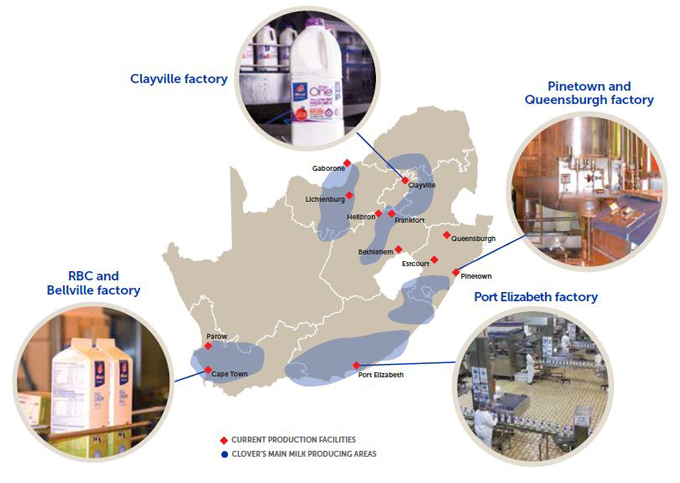
Once the raw milk has passed all quality tests, the milk is processed at Clover’s 13 production facilities across South Africa and in selected African countries. The type of products produced include fresh milk, UHT milk, flavoured milk, as well as concentrated type products such as cheese, butter and milk powder. For the manufacturing of beverage products, the base ingredient, generally in concentrate form, is procured from carefully selected suppliers who are contracted to ensure consistent and high quality materials are used in the manufacturing process. The concentrate is mixed with good quality water to manufacture the final product such as Krush Juice and Tropika. In bottling water, water is extracted from a selected natural ground water source, upon which vigorous tests are routinely performed to ensure ongoing quality and safety of the water source.
| Facility | Product type |
| Bethlehem | Milk powder |
| Clayville | Cream (UHT and Fresh) |
| Dairy fruit mix (Fresh and UHT) | |
| Milk (UHT) | |
| Clover Krush | |
| Estcourt | Milk powder |
| Frankfort | Butter |
| Ghee | |
| Milk powder | |
| Heilbron | Condensed milk |
| Buttermilk powder | |
| Lichtenburg | Cheddar cheese |
| Gouda cheese | |
| Mozzarella cheese | |
| Tussers cheese | |
| Feta cheese | |
| Parow | Butter |
| Clover fruit juice | |
| Cream (Fresh) | |
| Dairy fruit mix | |
| Milk | |
| Pinetown | Milk (UHT) |
| Port Elizabeth | Dairy fruit mix (UHT) |
| Milk | |
| Cream (UHT) | |
| Queensburgh | Dairy fruit mix |
| Maas | |
| Milk Fresh and Extended Shelf Life | |
| Steri flavoured milk | |
| Milk (UHT) | |
| Clover Krush | |
| Dairy fruit mix | |
| Maas | |
| RBC (Parow) | Quali/Real Juice |
| Clover Waters | Water |
| (Doornkloof) | Iced Tea |
| Inhle | Aquartz |
| (contract manufacturer) | Iced Tea |
Infrastructure
Clover owns most of its properties, which are built to meet at least the minimum specifications of the national building regulations. For all Clover sites the buildings and equipment are comprehensively insured including for potential loss of profit as a result of business interruption incidents. Reliable supply of utilities to meet the needs of production on a daily basis, is a pre-requisite for good market supply. New innovation in technology creates an opportunity for Clover to consolidate some of the facilities through which various synergies would be achieved. Clover constantly assesses and reduces cost in its supply chain to ensure Clover remains cost competitive, while also lowering its impact on the environment.
The factors that affect the availability, quality and affordability
Given the technological progress being made on a daily basis, the ability of companies to compete over the medium term necessitates continuous investment in order to improve efficiencies and reduce costs. Failure to do so would lead to an ineffective cost structure and an unattractive, uncompetitive product offering. By way of example, Clover improved its competitiveness with Project Cielo Blu which was completed in August 2013. The juice and Tropika factory which was established in Clayville, also increased Clover’s production capacity. More specifically, through the Cielo Blu Project, Clover improved its competitiveness by moving its UHT and juice manufacturing facilities to more appropriate manufacturing locations resulting in several cost savings. This resulted in the development of new technology used to recover milk protein content, which previously went to waste. This can be used as the dairy additive required in the manufacture of Tropika as opposed to traditional fresh milk or milk powder, resulting in cost savings going forward. To ensure long-term value creation, Clover monitors the following measures:
- Depreciation vs Capital Expenditure – Key Risk Indicators
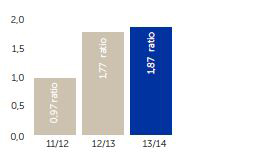
The quality of Manufactured Capital will decrease if net investment is not positive. When capital expenditure is higher than depreciation, the Company invests not merely to keep the quality of manufacturing assets at the same level, but also to improve efficiency and effectiveness. An organisation whose depreciation exceeds capital expenditure over the medium term would suffer a significant decrease in the quality of manufacturing assets. As can be seen, since the 2012/2013 financial year, Clover has invested substantially to enhance the quality of its manufacturing assets and also to cater for medium to long-term growth.
CAPITAL EXPENDITURE VS DEPRECIATION
Financial year
The organisation’s expectations of its ability to produce flows from its manufacturing assets to meet future demands.
Sales growth is only possible if the manufacturing capacity exists to meet the higher volumes of production required. The ability of the organisation to manage available capacities pro-actively, is critical in order to meet unexpected demand and to reduce capacity as required in order to keep lowering unit production costs on a continuous basis.
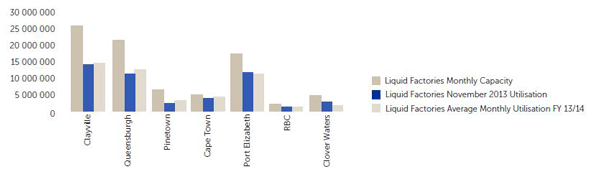
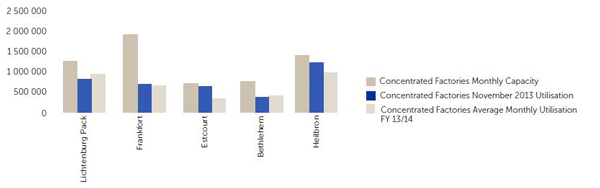
As a measure of Clover’s ability to continue producing income and other flows, it is important that the capacity utilisation per product group is within best practise. As milk intake is seasonal, with increased milk intake between August and January in any given year, certain factories are working at full capacity in the seasonal peak cycle, whereafter production reduces substantially in the off season. Therefore Clover’s capacity in the seasonal peak determines limits for increased milk intake. As our business is highly seasonal for some products, the average value as well as the peak (November) value have been communicated. For a seasonal product, the peak value is more illustrative.
LIQUID FACTORIES CAPACITY UTILISATION
litres
CONCERNTRATED FACTORIES CAPACITY UTILISATION
kilograms
- Material trade-offs and interdependencies between capitals
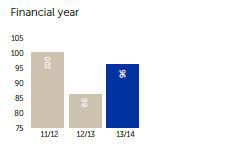
Technological progress and the need to continuously improve, impacts the Natural Capital and Human Capital of the organisation directly. The labour requirements of the Company are changing in terms of the required skills level and capabilities. New ways of doing things also impacts on the amount of labour required per unit production. The impacts thereof is monitored by the measurement of production per manhour worked in manufacturing. Progress in this regard improves the ability of the Company to afford a more expensive/skilled labour force. Due to Cielo Blu, infrastructure changes which resulted in an interruption of the normal production process, a reduced output per manhour in 2012/2013. The 2013/2014 results were impacted by low milk intake occupied factories, which was deemed to be of a temporary nature.
OUTPUT PER MANHOUR WORKED
Financial year
Sales, Merchandising and Distribution
Distribution Networks
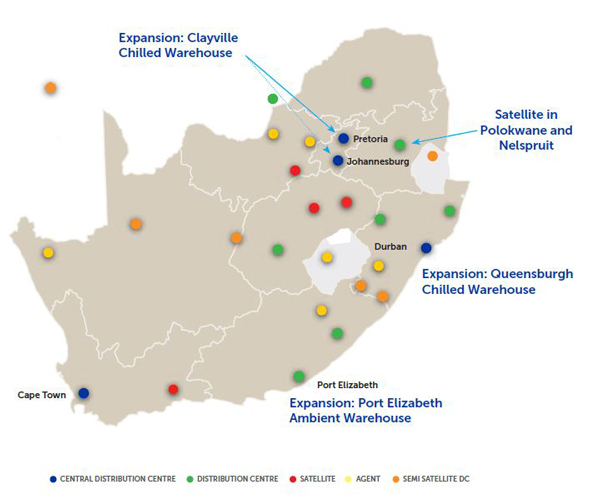
Clover makes use of its Primary Distribution Department to move all products from its factories to its distribution facilities across South Africa. On a daily basis, Clover receives customer orders electronically or telephonically at the Customer Call Centre from where orders are processed to be delivered from one of Clover’s 28 distribution centres to approximately 14 913 delivery points in South Africa. Clover also has agreements with several principal customers on whose behalf Clover performs distribution and in-store merchandising services at retailers.
Despite specialising in distribution and sales of chilled products, Clover also handles a significant basket of non-perishable food products. In leveraging its capabilities, Clover provides sales and/or distribution services to a host of valued principals, including the likes of:
- Unilever;
- Eskort;
- Foodcorp;
- Orley Foods;
- Epic Foods;
- Enterprise;
- Red Bull; and
- Danone.
Project Cielo Blu was completed in the 2012/13 calendar. The aim of the project was to address Clover’s capacity constraints in Gauteng, KZN and Port Elizabeth. The distribution network was also re-engineered to a hub-on-spoke model enabling Clover to reduce stockholding and improve stock planning and replenishment.
Distribution network is a key enabling platform. It provides a sustainable competitive advantage to Clover and is central to the growth strategy for Clover and principal products.
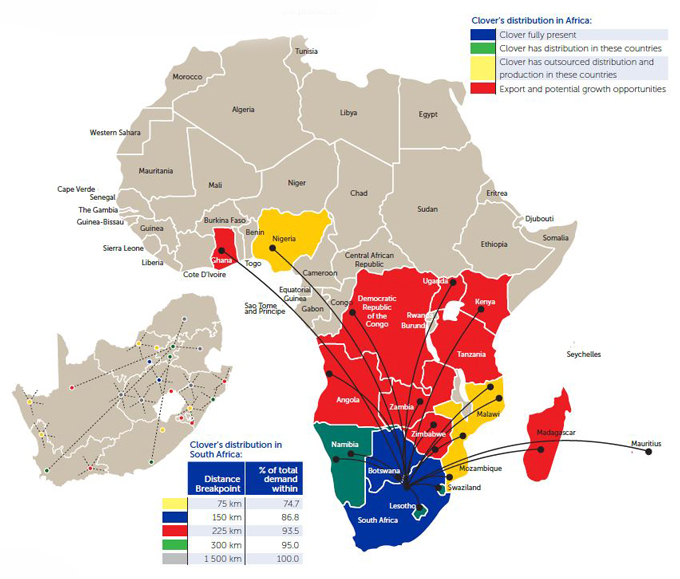
Stores receive direct deliveries of Clover products between two and five times per week, depending on sales volumes. Over 580 delivery vehicles are delivering stock to over 14 913 delivery points. Over 800 SKU (stock keeping units) are stored, picked, delivered and merchandised in Clover’s distribution network. More than 50% of all refrigerated diary and processed meat products delivered to stores are being supplied through the Clover Distribution Network.
Clover has also embarked on a sales initiative (Masakane Project) to grow the distribution footprint into the bottom-end markets. During 2013/14 financial year Clover added 3 309 additional delivery points or customers to its network. Currently there are 16 project teams active and we plan to extend this to 30 teams during the course of the year.
Sales (Project CAMPRO)
Clover is committed to continually improving its business processes. One of the ways in which we achieve this objective is by embarking on projects that will underpin changes in the following areas:
- Product category development;
- Better understanding of shopper behaviour; and
- Sales execution.
In 2013, Clover embarked on a programme to investigate and improve the way we work across the sales functions. Clover contracted an international consulting firm, Renoir, to assist. The project focused on three separate work streams, namely revenue enhancement, cost reduction and limiting distribution losses. It was found that Clover had pockets of excellence, but required standardisation in the “way we work” across the Company.
A diverse team of six Cloverites were identified to work hand in hand with Renoir to deal with problem identification, root cause analysis and generating, evaluating and implementing solutions. On completion of the project in 2014, the team managed to show immediate savings. Furthermore the sales force utilisation, understanding and compliance to the newly introduced systems and procedures improved to more than 90% during the course of the project.
The CAMPRO Project therefore enabled Clover to establish its own internal change management department, with the ability to identify opportunities, analyse net results and implement change management practices for continuous improvement.
CLOVER Merchandising is “WAY BETTER”!
Clover has 2 456 permanent merchandisers deployed nationally who provide a service to over 3 000 retail and wholesale outlets. These merchandisers work a maximum of 45 hours per week, and depending on volume and type of outlet, weekend merchandising services are also provided.
Clover merchandisers ensure that all Clover and principal products are correctly merchandised on shelf. Merchandisers in collaboration with store management and Clover sales staff are responsible for ensuring that products appear in the right shelf/placement within the store, are available at all times and in the correct quantities. It involves working closely with the store management team, as well as Clover’s sales teams.
Quality
Quality over final product produced
All Clover products are produced in terms of International Best Practices, regarding quality, hygiene and food safety. All Clover factories are ISO 9001 and HACCP certified and accredited by third party auditors and comply with all International Standards, required for food safety and quality management systems.
Clover Quality Assurance performs various tests in all stages of the production process of all its products, through highly trained technicians, in well-equipped laboratories to ensure constant quality, food safety and meeting minimum legal regulatory requirements.
Occupational Health and Safety
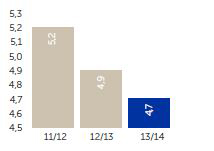
Employees can only operate efficiently and effectively in a safe and healthy working environment. Formal health and safety policies are in place as well as systems and processes are implemented and monitored. There is a standard health and safety procedure for every potentially dangerous substance or operation in the workplace. All of Clover’s production facilities and major distribution facilities were audited during the review period. Measures complying with all applicable environmental legislation and the Occupational Health and Safety Act (“OHS”) were used. Audits are conducted annually to monitor continuous improvement. The Lost Time Injury Frequency rate has improved during the period under review.
LOST TIME INJURY FREQUENCY RATE per million manhours
INTELLECTUAL CAPITAL
Brands and reputation
Clover’s Marketing Department has over the years developed several household brands including Clover, Tropika, Butro and Krush, just to name a few. Continuous marketing efforts are required to ensure Clover’s brands remain relevant.
Clover has enjoyed a long and successful history as part of the development of South Africa’s dairy and fast moving consumer goods industry. Clover has been a household name for more than 100 years. Today, Clover is a leading and competitive branded consumer goods and products group operating in South Africa and other selected African countries with its core competencies in the production of dairy and non-dairy beverage consumer products, the distribution of chilled and ambient consumer products and the sales and merchandising of consumer goods.
Clover has won numerous accolades thereby confirming its status as a trusted household name. Some of the awards bestowed on Clover includes:
- South Africa’s leading Iconic Brand in the fresh milk category for 2014; and
- Winner of Reader’s Digest’s Most Trusted Brands for 2014.
That being said, Clover takes pride in announcing its market shares as at 30 June 2014 in all major categories of dairy products available on the market:
| Clover’s Percentage Market Share as at 30 June 2014 | June 2014 Market position | |
| Fresh milk | 29,4 | 1 |
| UHT Milk | 17,5 | 3 |
| Cream | 40,1 | 1 |
| Butter | 33,8 | 1 |
| Feta cheese | 33,0 | 2 |
| Natural cheese | 33,3 | 1 |
| Natural pre-packed cheese | 30,4 | 1 |
| Processed cheese | 10,1 | 3 |
| Pure fruit juice | 44,9 | 1 |
| Dairy mix | 68,2 | 1 |
| Fruit nectar | 29,6 | 1 |
| Iced Tea | 21,9 | 2 |
| Bottled water (including Aquarts and Nestlé) | 17,7 | 3 |
| Flavoured milk | 32,3 | 2 |
| Maas | 8,1 | 3 |
Trademarks and Patents
Clover is the proprietor of more than 916 registered trademarks within the following jurisdictions:
| Jurisdiction | Number of trade marks |
| South Africa | 368 |
| Rest of Africa ** | 536 |
| Other countries ** | 12 |
| ** |
Clover further holds 11 patents registered in South Africa and Namibia.
Clover’s intellectual property is protected through employment contracts, confidentiality agreements and/or licence agreements. Clovers intellectual property portfolio is further managed through competent patent and trademark attorneys.
Product Innovation and Technology
Clover is focused on the ongoing revision and revitalisation of its marketing strategy by growing its brand basket and successfully maintaining existing brand market shares. This is done through developing new value added products and leveraging from its existing strong brands in the dairy and beverages categories to increase Clover’s profitability. New products will either be developed by CIover’s in-house Product Innovation and Technology Department or in co-ordination with a joint venture-like partnerships such as recent Clover Futurelife JV to produce a nutritional health drink.
Clover’s Product Innovation Department ("PIT") is constantly looking to improve its current product offerings through improved product formulations and improved packaging, working towards ‘greener’ alternatives. These projects initiated also generally result in cost savings. With a dedicated PIT department, Clover is able to constantly evaluate new product opportunities that would complement its existing basket of products.
Clover’s Technical Department is responsible for the construction of new factories as well as new production lines according to product specifications determined by PIT. All new lines installed have to meet product quality and safety standards benchmarked against international best practices. This is to ensure that the production environment is free from harmful bacteria not suitable for human consumption. The Technical Department ensures that all production staff are trained prior to the commencement of production.
Information Systems
Clover has an in-house Information Technology Department to support the business on its BPCS ERP environment, while also being at the forefront of supplying and developing Clover’s management reporting. Please refer to the Governance, Risk and Compliance Report where this has been discussed in detail on page 48.
Fresh milk
Clover is the market leader in fresh milk. In order to maintain our number one position and reinforce our leadership, Clover focuses on differentiation and innovation, underpinned by superior quality, providing consumers with solutions that make their lives Way Better.
UHT milk
The quality and goodness of UHT milk is kept fresh for longer due to the UHT (Ultra High Temperature) process and special packaging that allows the product to be stored for a period of nine months without refrigeration.
Cream
Clover cream is ultra-pasteurised to ensure a superior quality product with an extended shelf life. Clover aims to increase its markets share in this segment by creating awareness and educating consumers on the multiple uses of cream. The packaging used for our cream products are dedicated to recipes and communication on all areas of cooking and baking where cream can be used.
Butter
Clover is the largest manufacturer of butter in the country. Clover is the market leader in this segment, including such well-known brands as Clover Mooi River salted butter, Clover Springbok unsalted butter and Butro butter spread. Clover butter is a natural product without any additives, artificial colouring or flavouring.
Feta Cheese
Clover feta cheese is the second largest brand in the market on and is competing for the number one position. In this extremely price sensitive market, Clover recognises that it is important to ensure pricing and quality are right. Further to this, Clover promotes feta below the line to drive growth and quality.
Clover’s range of cheeses
For over 100 years, Clover cheeses have been making mealtimes more delicious. This is because they are made according to the highest quality standards, with care and dedication.
Clover is the market leader in the pre-packed cheese segment with Clover and Elite cheese sharing in this category. Clover’s award-winning individually wrapped processed cheese is indicative of Clover’s clear ambition to provide consumers with the highest quality, best tasting products. New Clover individually wrapped processed cheese slices are preservative free and made with great tasting, excellent quality ingredients. Sacca cheese enjoys great heritage as it has been available since 1914. Elite Gouda is the only gouda in South Africa that is made in the traditional way.
Clover Krush
Clover Krush is a premium, 100% fruit juice blend, available in 10 exciting flavours and caters for the entire family. Clover Krush will ensure not only a great healthy alternative, but the delicious tastes of nature with uncompromising everyday goodness. No sugar or sweeteners are added to the juice and it is enriched with Vitamins A, C and E. Clover Krush is the market leader in the pure juice, short life fruit juice market
Tropika
Tropika is made from a combination of fruit juice and dairy, which results in a unique smooth tasting beverage. After nearly 30 years in the South African market, Tropika is still the market leader in the Dairy Fruit Mix category and the bestselling fruit juice beverage in South Africa.
Danao
Danao is a dairy fruit mix drink containing real fruit juice and dairy with added vitamins A, B2, B12, C and Calcium. The brand focuses on the inherent goodness of fruit juice and dairy – “Double the Happiness”. The plan is to broaden the appeal from being a breakfast drink to an all-day, any time refreshment with an extended consumer target market.
Clover Life Nectar
Clover Life Nectar range offers consumers a delicious, refreshing juice nectar that is affordable enough to purchase regularly. Clover Life has always been a favourite in South African homes and occupies the number one position in the Fruit Drink/Nectar category.
Manhattan IceD Tea
Manhattan Iced Tea is the second biggest ready to drink Iced Tea in South Africa. Manhattan Iced Tea is a non-carbonated beverage with a tea extract base and fruit flavour blends. Manhattan Iced Tea has three tea extract variants, black, green and white tea, which is then blended with a variety of fruit flavours or fruit blend combinations, to give a refreshing and tasty ready to go Iced Tea.
Aquartz Natural Mineral Water
Aquartz is a natural mineral water that is bottled directly at source, this is to ensure the highest quality, purity and safety. The Aquartz water source is a naturally sweet mineral water that is low in TDS’s ("Total Dissolved Salts"). Aquartz is available in natural mineral water or in sparkling flavoured water options.
NestlÉ Purelife Mineral Water
Nestlé Purelife is a pure, still or sparkling mineral water that is bottled directly at its unique source, ensuring a good balance of minerals and a crisp mouth sensation that revives your palate and is pure hydration for the whole family.
Amasi
Amasi (so called in Zulu and Xhosa, and “maas” in Afrikaans) is the common word for fermented milk that tastes like cottage cheese or plain yogurt. Clover brings the love for tradition into dairy with Clover Amasi. Clover’s maas recipe is rich and creamy to reignite the love in their customers hearts with this cultural and delicious treat.
Super M
Super M is the coolest teenage flavoured milk. It is available in four great flavours: chocolate, strawberry, banana and cream soda. Where the competing market leading brand’s strategy is based on flavour, offering a variety of flavours for each consumer, Super M decided to follow global trends and offer variety in pack sizes in the top four selling flavours.
Condensed Milk
Full-cream sweetened condensed milk manufactured by Clover is prepared from standardised bovine milk and pure refined sugar. The product does not contain any preservatives except sugar.
HUMAN CAPITAL
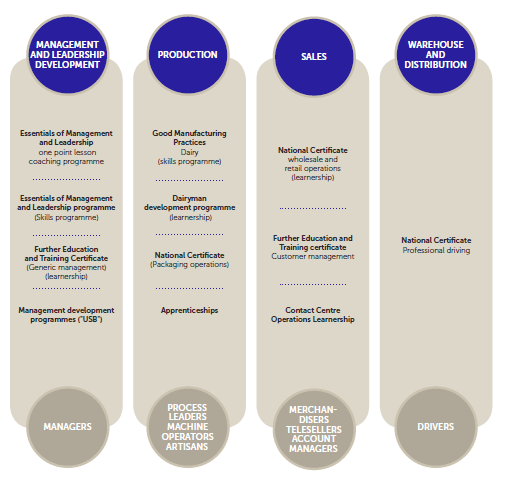
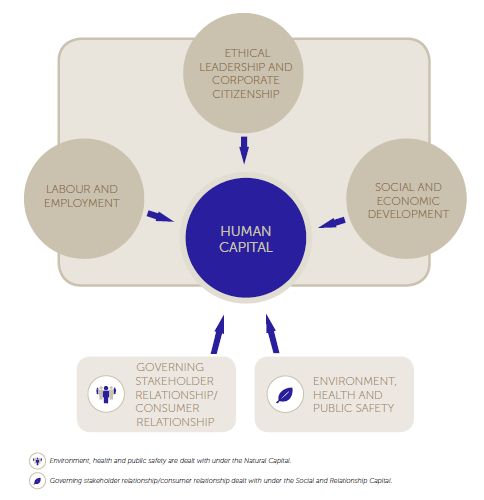
Clover constantly strives to improve employee competencies by providing ongoing training through skills development programmes focusing on areas where there is a general shortage of skills. For Clover to remain at the forefront, it needs to constantly innovate and improve its business model requiring the appropriate staff complement in support thereof through lucrative attraction and retention strategies. All of this is done in compliance within the labour related regulatory universe. Clover also aspires to achieve objectives set out in respect of employment equity.
The Human Capital Strategy (Project Driven):
- Focuses on positive initiatives to ensure the long-term sustainability of the business;
- Acknowledges that the right people are the primary source of a competitive advantage; and
- Contributes to the establishment of an engaged workforce that strongly identifies with the company’s vision and mission and objectives.
The Human Resources Department works closely with other business units to ensure that risks associated with Human Capital are identified and addressed. Special focus is also placed on regulatory compliance as it relates to day-to-day activities at Clover. The Human Resources Department is pro-active in supporting the business to utilise opportunities that will add value to the business and its 6 424 permanent employees.
Project Driven outlines Clover's strategy for addressing the Human Capital's response to:
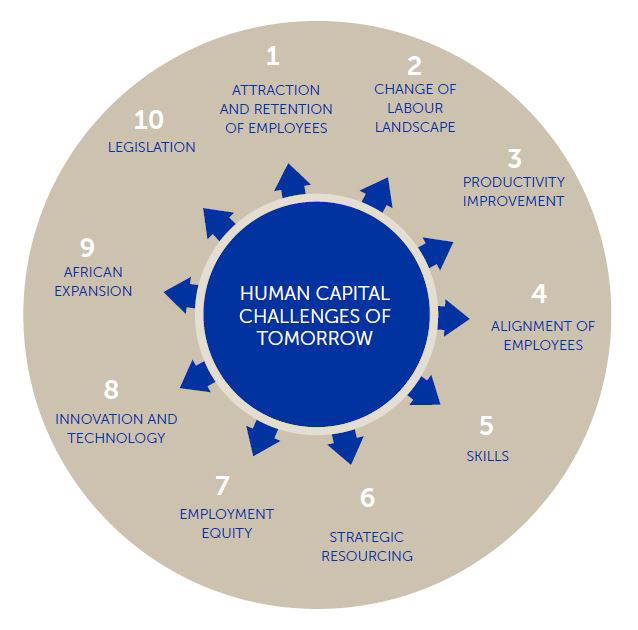
1. |
Labour and Employment |
||||||||||||||||||||||||||||||||||||||||||||||||||||||||||||||||||||||||||||||||||||||||||||||||||||||||||||||||||||||||||||||||||
Following the launch of Project Driven during 2013 the Company reconfirmed its strategic focus with regard to human capital:
|
|||||||||||||||||||||||||||||||||||||||||||||||||||||||||||||||||||||||||||||||||||||||||||||||||||||||||||||||||||||||||||||||||||
|
|||||||||||||||||||||||||||||||||||||||||||||||||||||||||||||||||||||||||||||||||||||||||||||||||||||||||||||||||||||||||||||||||||
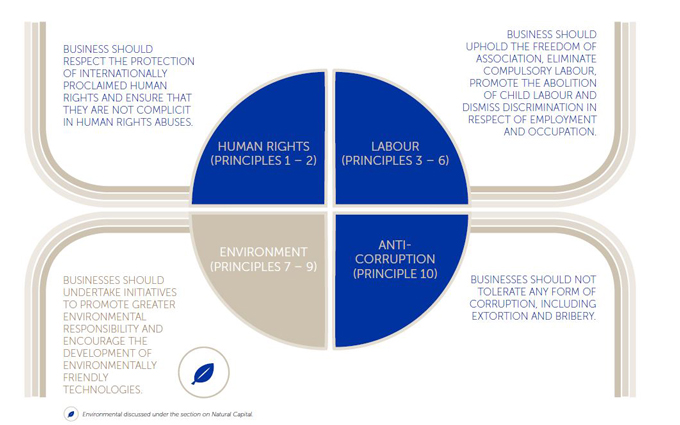
Ethical leadershipClover and its leaders have adopted a philosophy that respects the rights and dignity of others. At Clover we are aware of how our decisions influence others, and these principles are integrated in our thinking and decision making processes. Our ethical leadership principles are an integral part of our vision and mission, and are demonstrated by our people through the execution of their functions and projects. Effective leadership based on an ethical foundationClover’s strategy to build a sustainable business considers the long and short-term impacts of our operations on the economy, society and the environment. It is our intention not to compromise the environment, and we consider the impact of our operations on both internal and external stakeholders. Promotion of equality, prevention of unfair discrimination and reduction of corruptionClover is committed to the promotion of equality, and prevention of unfair discrimination with all its stakeholders, as is demonstrated in the Clover Ethics policy. We are committed to using our best endeavours to adhere to the following principles:
|
|||||||||||||||||||||||||||||||||||||||||||||||||||||||||||||||||||||||||||||||||||||||||||||||||||||||||||||||||||||||||||||||||||
NATURAL CAPITAL
The growing demand for natural resources will force dairy companies to process products more efficiently by lowering its carbon and water footprint by making use of the latest technologies in South Africa similar to those already developed in Europe. In addressing its dispersed factory locations, Clover is evaluating its options to consolidate these factories and install latest technology, enabling it to improve its cost competitiveness, while also achieving synergies in sustainability of its operations, such as reduction in Clover’s carbon and water footprint. As some of the technologies are expensive, Clover is constantly reviewing available government tax incentives and grants to ensure business cases are viable and that the project would result in Clover to be more cost competitive at a unit cost level.
Clover is evaluating available government incentives within Agro processing, to benefit cost competitiveness of milk producers, including black farmer development.
| Objective | Outcome |
| Continuously improve on environmental performance. | Implement and maintain an effective environmental management system (“EMS”). Provide a structured framework for continual improvement. |
| Inform staff on the EMS and policy and equip them with skills to achieve requirements of the policy. | Staff engagement, formal development and training. |
| Ensure consistent quality of products in line with legal, regulatory and best practise requirements. | Implement quality assurance models in both Clover’s milk collection as well as the production environments with laboratories monitoring and testing quality of products. Ultimately quality is monitored through feedback at Clover’s Consumer Centre handling general enquiries, complaints as well as compliments. |
| Reduce carbon footprint. | Quantify the carbon footprint associated with operations and key elements of the supply chain. Set annual targets for reducing Clover’s overall climate impact. |
| Reduce water usage across operations. | Monitor water usage and set targets for reducing water consumption. |
| Limit the generation of solid and liquid waste and the impact of their disposal. | Implement programme, monitor waste sent to landfill and set targets for reducing waste to landfill. |
| Minimise returns and damages and the impact thereof on the environment. | Implement programmes and monitor. |
| Reduce energy consumption and associated emissions. | Monitor energy usage and set targets for reducing consumption. |
| Manage impacts for on-site storage of fuels and chemicals, both during normal operation and in the event of spills and emergencies. | Implementation and monitoring of procedures. |
| Optimise the use of primary and secondary packaging. | Monitor wastage and implement improvement processes and targets. |
| Adhere to all applicable environmental legislation. | Continuously review and revise the ambit and effectiveness of the EMS. |
| Ensure continuous monitoring of and reduction in the impacts associated with milk supply. | Support and development of the Best Farming Practices Programme. |
| Inform supply chain partners on activities to reduce environmental impact and partner with them to reduce their own impact. | Formally engage with partners in the supply chain. |
| Ensure Health and Safety throughout all operations. | Continuous monitoring to ensure safe working environment. |
Environmental
Clover strives to manage its business in such a manner that the environment is adequately protected, the use of natural resources is minimised, and that environmental management programmes are established to contribute towards the sustainability objectives of the company. Clover’s green initiative strategy was formalised and commenced in the 2011 financial year with the aim of establishing a formal environmental sustainability (“green”) strategy. In terms of achieving this vision, Clover recognises its responsibility to reduce, and as far as possible, to eliminate the impact of its business on the environment. Clover recognises that in achieving environmental excellence, it would obtain a competitive advantage over its peers, as a food manufacturer’s energy and services costs comprise approximately 30% of fixed costs.
This responsibility not only relates to operations within Clover’s control, but also to Clover’s supply chain partners, who in the course of supplying Clover, could be responsible for significant environmental impacts. In the realisation of this responsibility, Clover has developed an environmental management system (“EMS”) which provides a structured framework against which continuous improvement can be measured. Clover actively monitors environmental, health, safety and quality through the use of its dedicated Entropy risk management system and other forms of assurance. It is envisaged that the Entropy measurement will be progressively extended to other areas of environmental sustainability.
The Social and Ethics Committee requires each business unit to regularly report its impact on the environment based on agreed measures. The Chief Engineer: Maintenance and Safety, Health and Environment (“SHE”) for production together with the Divisional Engineer for distribution are both responsible for reporting on Clover’s green strategy and on the SHE compliance to the Social and Ethics Committee on a quarterly basis.
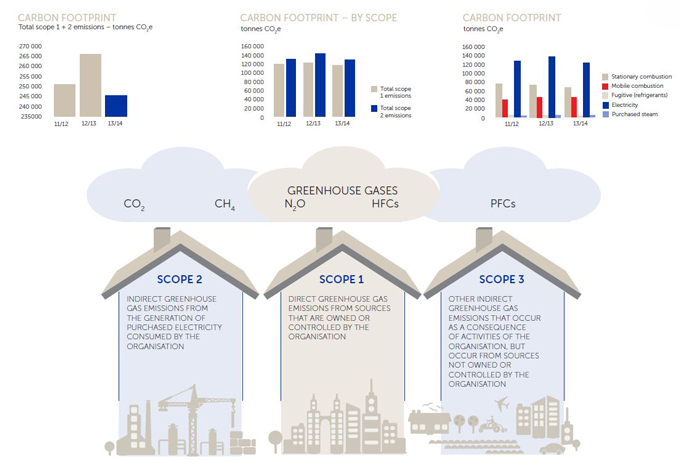
Water, Electricity, Fuel, Wastage and Carbon footprint
Clover invests in air filtration to ensure that products are produced in hygienically safe conditions to ensure that quality standards are adhered to, irrespective of external air quality. Clover is also actively striving to reduce carbon emissions per unit produced. This is especially relevant in an environment of constantly above inflation increases in the cost of electricity and fuel. Clover is reliant on a constant good quality water source to ensure that products meet its minimum quality standards.
In areas where water quality is inconsistent, Clover installs water purification/filtration systems to ensure a quality water supply to the factory. Clover is exposed to areas where factories are located in water scarce areas, as no factory can be operational without water supply which is required to clean manufacturing lines on completion of production batch runs or where water is used as a base of the product, such as juice. Future climate change may also impact on milk supply areas and available supply. Clover makes use of available grants and tax allowances to implement “Green technology’’ reducing its carbon and water footprint to improve its operations to be more sustainable in future. This will also result in the reduction of Clover’s cost to produce, and enhancement of its competitiveness.
Waste and operational efficiency
| 2011/2012 | 2012/2013 | 2013/2014 | |
| Water consumed per kg of product produced | 4,353 | 4,5616 | 4,2902 |
| Electricity consumed per kg product produced (kWh/kg) | 0,1553 | 0,1735 | 0,1505 |
| Fuel consumed for steam generation (coal, diesel, HFO) per kg product produced (kWh eq/kg) | 0,4912 | 0,5229 | 0,4509 |
| Waste to landfill in kg per kg produced | 0,0155 | 0,0147 | 0,0097 |
| Waste recycled (kg) | 1 100 503 | 2025670 | 1 793 590 |
| Lost time injury frequency rate | 5,21 | 4,90 | 4,74 |
| Carbon Footprint | |||
| Total Scope 1 and 2 emissions (tonnes Co2 eq) | 250 869 | 265 627 | 245 357 |
| Total Scope 1 emissions (tonnes Co2 eq) | 119 605 | 122 765 | 116 659 |
| Total Scope 2 emissions (tonnes Co2 eq) | 131 264 | 142 862 | 128 698 |
| Trends per Source | |||
| Stationary combustion (tonnes Co2 eq) | 75 633 | 72 827 | 67 304 |
| Mobile combustion (tonnes Co2 eq) | 39 954 | 44 956 | 45 595 |
| Fugitive (refrigerants) (tonnes Co2 eq) | 4 018 | 4 982 | 3 759 |
| Electricity (tonnes Co2 eq) | 127 678 | 137 397 | 123 955 |
| Purchased steam (tonnes Co2 eq) | 3 586 | 5 465 | 4 744 |
Carbon footprint
Clover’s carbon footprint extends over the operations of the following five business units:
| Business unit | Description/key activity |
| Head office | Corporate administration, marketing, management |
| Procurement | Transportation of raw milk and materials from suppliers to Clover facilities |
| Production | Facilities for the processing, packaging and dispatching of products |
| Primary distribution | Transport of products from production facilities to primary and secondary distribution centres |
| Secondary distribution | Clover controls a large number of secondary distribution facilities across South Africa that handles own and principal clients’ products. Distribution is to retail customers through leased vehicles, under the control of Clover |
SOCIAL AND RELATIONSHIP CAPITAL
Clover has its own Corporate Social Investment programme, which the Group developed to support community projects. Clover identified all its material stakeholder groups and prioritises its stakeholder concerns as part of its risk management activities.
Clover Mama Afrika
Good corporate citizenship
Clover prides itself in conducting business by taking into account our legal, ethical and economic responsibilities. While it is our goal to preserve profitability for our shareholders, we also aim to create higher standards of living and quality of life in the communities in which we operate.
- Corporate social and community investment
Clover Mama Afrika Trust was started ten years ago in 2004.
Over the past decade, Clover Mama Afrika has established a
reputation for being one of the country’s most innovative,
effective and sustainable corporate investment programmes,
bringing tangible benefits to the people it aims to uplift.
The Clover Mama Afrika initiative has set out to restore some of the best aspects of African tradition into modern life, such as caring for one another, passing on skills and protecting the young, the weak, the aged as well as HIV/ AIDS victims. Today, the Clover Mama Afrika project places a strong emphasis on assisting people in disadvantaged communities to learn to help themselves so that they may regain their pride, establish self-sustaining livelihoods and become valuable members of their communities and to society at large.
At the heart of the programme are the carefully chosen “mamas” who already act as pillars of strength in their communities. Hand-picked by Clover, the mamas are incredibly special ladies who already make a difference in the lives of the people around them and want to empower others to become self-sustaining too. The programme sees that they are trained in a variety of essential skills that can then be passed on to other community members. Cooking, baking, sewing, curio making, hair care and food gardening are just some of the training they receive and significantly, they are also presented with the necessary tools, equipment and infrastructure to create an income for their communities on the back of their newly acquired skills. Currently, the Clover Mama Afrika project has 40 Mamas countrywide who collectively care for over 15 500 children and more than 2 500 elderly across the whole of South Africa.
Value drivers of the Clover Mama Afrika initiative
-
Skills selection centres
Relevant, employable and marketable skills are aligned to the needs of each respective community to ensure that the centres become self-sustainable. After skills-training, Clover Mama Afrika provides start-up equipment to allow for immediate income generation and passing on of skills.
-
Site improvement
Clover Mama Afrika assists communities with the repairs and renovations to basic facilities such as appropriate ablution facilities. It is important for us to create a safe haven for all the children in the care of a Clover Mama Afrika.
-
Monitoring and Evaluation
Regular monitoring and evaluation of each self-help project is implemented, which allows for the identification of strengths and weaknesses on an individual basis. Immediate support and assistance is provided where necessary.
-
Partners
Clover is of the firm belief that the best way for Clover Mama Afrika to have the greatest possible impact is through partnership and collaboration with other organisations and individuals that want to embed sustainability into the fabric of South African society. Besides, the wide-ranging needs of South African communities require committed teamwork from as many people as possible who have the means to make things happen for those who are less fortunate.
Hugely important to the success of Clover Mama Afrika is the open-hearted attitude of the programme’s corporate partners and sponsors who assist to make it meaningful for so many needy people across South Africa. Professor Elain Vlok, Clover’s manager of Corporate Services who drives Clover Mama Afrika with passion, dedication and insight, believes that the programme’s on-going success is built on a generosity of spirit that is at the same time, the very essence of “Ubuntu”.
Blue chip partners which contribute to the success of Clover Mama Afrika and co-fund 40% of the Trust’s expenses include: - Expeditors International;
- HCI Foundation;
- Eqstra Holdings Limited; and
- MiX Telematics.
- Consideration of community interests;
- Corporate social investment and donations;
- Preferential procurement policy; and
- Clover Mama Afrika.
- Research in gaining consumer insights in product categories;
- Regular communication on all core brands via social media;
- Effective consumer centre dealing with complaints and enquiries;
- GDA table (Guideline daily amount) informs consumers of nutritional values in Clover products;
- Cost competitiveness of products; and
- Food safety standards.
- Quality of products;
- Effective product stewardship;
- Effective merchandising services;
- Valued partnerships to drive efficiency and continued future growth;
- Promotional activities;
- Trading terms;
- Category expansion; and
- Cost efficiencies.
- Health and safety;
- Ongoing training and development;
- Open communication between employees and managers;
- Transformation in line with EE Plan; and
- Access to HIV counselling and employee wellness programmes.
- Increased contribution to the South African economy, including job creation and youth development;
- Good corporate citizenship;
- Timeous payments of taxes;
- Empowerment, transformation and adherence to the revised BEE Codes;
- Reduction of energy consumption;
- Disclosure and management of carbon emissions; and
- Provide input on policy changes in the agricultural sector and food security.
- Adequacy of fire protection measures; and
- Maintenance of fire protection equipment.
- Transparent and responsible reporting; and
- Non-compliance to legislation.
- Large fluctuations in milk prices;
- Increases in farm overhead costs; and
- Land reform.
- Delivering consistently superior financial results for sustainable growth;
- Leadership and strategic direction seizing strategic opportunities;
- Policies and procedures ensuring governance i.e. ERM Policy;
- Corporate governance and ethics;
- Progress with project pipeline and future growth projects;
- Capital expenditure for current and future periods;
- Effectiveness of risk management process; and
- Stability of IT systems.
- Long-term security of supply;
- Effectiveness of planned procure-to-pay process;
- Preferential procurement; and
- Efficiency with imports.
- Damage the image of Clover or the Clover brand name.
- Threaten the health or safety of the consumer and/or Clover personnel.
- Hold a contamination threat to the environment.
- Result in a consumer suffering damages as a result of a Clover product.
- Possibly result in negative publication in the media.
- Possibly result in legal action against Clover.
- Possibly result in the consumer referring the matter to the Consumer Council.
- Consumer Protection Act;
- Food stuff, Cosmetics and Disinfectants Act;
- Other labelling legislation; and
- Various other acts that impact our stakeholders.
- Clover factories are annually certified by the SABS on ISO 9001 as well as ISO 22000 in respect of Port Elizabeth.
- Clover factories are annually certified by the SABS on HACCP standards.
- Clover is subjected to SEDEX audits from its clients on an ad hoc basis on selected factories.
- Safety audits are performed internally as well as by Makrosafe covering all Clover sites.
- Marsh performs fire risk surveys over a three year cycle of all Clover’s sites.
- Internal and External Audits are performed on assets.
- Internal Audit benchmarked Clover’s Integrated Annual Report against GRI 3 and GRI 4 principles.
- Internal Audit assessed Clover’s carbon emissions calculations.
- Deloitte Best Company to work for survey.
- Internal Audit gave independent assurance over the risk management function.
- Clover was assessed as a Level 6 contributor on the last EmpowerLogic assessment performed in respect of Clover’s June 2013 year-end.
- Clover brands have won numerous accolades confirming its status as a trusted household name.
- Clover’s portfolio of trademarks and patents are managed by Adams and Adams attorneys.
- Clover’s migration to eRMS ERP platform is currently been overseen by External Audit.
- Clover Mama Afrika positioned itself as a sustainable and effective CSI project as evident from prestigious awards received, with the PMR Diamond Arrow award most recently received in 2014.
- Clover received a full allocation of points on Social Economic Development as assessed at 30 June 2013 by EmpowerLogic.
- Internal Audit conducted a comprehensive audit on the Mama Afrika campaign.
- External Audit assess management’s representation over material internal financial controls.
- Unqualified audit opinion by External Audit.
- Internal Audit performed various financial control audits and provided an opinion on material financial controls.
Recipients of the Clover Mama Afrika project
Below is an illustration of the number of people who benefitted from the Clover Mama Afrika project during the 2013 and 2014 year ends:
| Skills training | Members trained 2013 | Members trained 2014 | Operating centres 2013 | Operating centres 2014 | Skills transferred 2013 | Skills transferred 2014 | Employed member earning wages/ salaries as reported 2013 | Employed member earning wages/ salaries as reported 2014 |
| Sewing | 101 | 107 | 29 | 28 | 640 | 1 501 | 93 | 60 |
| Bread oven project | 503 | 562 | 27 | 26 | 1 049 | 1 563 | 114 | 92 |
| Cooking and baking | 79 | 82 | 27 | 22 | 519 | 762 | 69 | 63 |
| Food gardens* | 549 | 557 | 25 | 23 | 577 | 684 | 36 | 28 |
| Quilting | 39 | 42 | 15 | 14 | 165 | 295 | 12 | 15 |
| Crochet and knitting | 49 | 28 | 35 | 15 | 553 | 454 | 37 | 16 |
| Hair-dressing | 16 | 18 | 3 | 4 | 16 | 67 | 12 | 13 |
| Pottery | 1 | 1 | 1 | 1 | 20 | 20 | 2 | 3 |
Value-added skills training
| Skills training | Members trained 2013 | Members trained 2014 | Operating centres 2013 | Operating centres 2014 | Skills transferred 2013 | Skills transferred 2014 | Employed member earning wages/ salaries as reported 2013 | Employed member earning wages/ salaries as reported 2014 |
| Poultry egg laying | – | 10 | – | 3 | – | 24 | – | 11 |
| Beadwork | 40 | 21 | 31 | 16 | 263 | 845 | 21 | 43 |
| Art | – | 40 | – | 26 | – | – | – | – |
| Flower arrangement | 37 | 39 | 11 | 12 | 244 | 523 | 18 | 19 |
| Mobile phones | 79 | 79 | 30 | 26 | – | – | 10 | – |
| Save a child | 175 | 125 | 13 | 13 | ||||
| Welding | – | 8 | – | – | – | – | – | – |
| MKI health information | 18 | – | 18 | – | – | – | – | – |
| Basic admin/finance | 27 | 45 | 27 | 27 | – | – | – | – |
| Totals | 1 713 | 1 764 | 292 | 245 | 4 046 | 6 738 | 424 | 363 |
Awards
Clover Mama Afrika has won prestigious awards since the inception of the project:
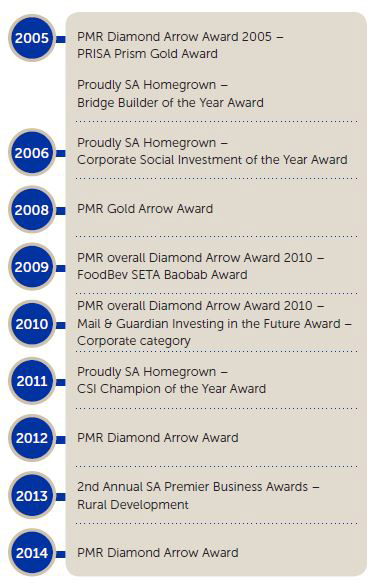
Clover Mama Afrika has positioned itself as a successful, award-winning example of a sustainable and effective CSI project, which is making a real difference in the lives of many needy South Africans.
Based on the most recent B-BBEE verification performed by Font, Clover achieved a full allocation of available points under the Socio-Economic Development section of the B-BBEE balanced scorecard. In addition, the Clover Mama Afrika project made a contribution to Enterprise Development which resulted in Clover achieving almost full points in this area on the overall scorecard.
As a respected JSE-listed company with a century-long history of serving farmers and the public through a wide range of world class “Way Better” dairy and beverage products, Clover is committed to maintaining Clover Mama Afrika’s status as a corporate social investment programme that makes a real difference. In line with its commitment to the programme, Clover also ensures that Clover Mama Afrika meets the highest levels of transparency and corporate governance.
Record of sponsorship and charitable givings
Clover’ sponsorship budget for the period under review was submitted and approved by Executive Management. Management is responsible for the tracking, accounting and reporting to the Social and Ethics Committee all sponsorships, donations and charitable givings. Supporting documentation is maintained by each business unit to enable transparent reporting. Sponsorships are used with a purpose of gaining brand awareness, corporate identity or consumer loyalty, which is aligned with Clover’s vision and mission.
Governing stakeholder relationships/consumer relationships
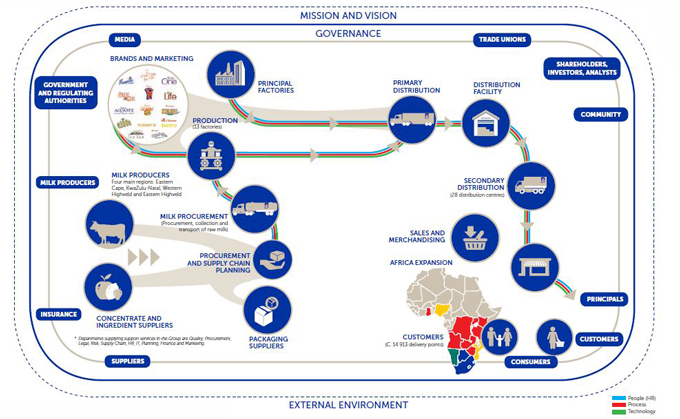
Throughout the 2014 financial year the Group has actively engaged with all its key stakeholders. Management have identified all material stakeholders as well as their legitimate interests in and expectations of the Group on a continuous basis as stakeholders’ interests in the Group are dynamic and subject to change. Once stakeholders are identified, management decides through consultation with the various stakeholder groups how to further engage with each constituency. This process forms part of the Group’s risk management framework. As a result of Clover’s diverse business model, Clover interacts through a wide range of functions within the business with various stakeholder groupings on an ongoing basis. The Clover stakeholders that have been identified are all stakeholder groups that can materially influence the attainment of Clover’s strategic objectives, but also more specifically it is those groups, individuals or entities, who can be affected by the actions and operations of Clover or, on the contrary, whose operations can materially impact on Clover’s operations. Amongst all the major stakeholder groupings identified, Clover has a distinct criterion for its strategic stakeholder partners whose relationships are required for the Group to attain its future strategic objectives.
CLOVER'S STAKE HOLDERS
Stakeholder engagement
| Stakeholder Group | How we engage with our stakeholders | Their contribution to value creation | What our stakeholders expect from us | What concerns our stakeholders | Method of Governance |
| Communities, traditional and civic society | Direct interaction through various corporate social investment initiatives and environmental campaigns in various communities | Participation with the community affords Clover the opportunity to understand their needs and to further align our business in a way that improves the lives of our communities at large | Ongoing commitment to our core strategic social investment initiatives adding to the wellbeing of the community | Corporate Governance policies | |
| Consumers | Promotions and community-based initiatives, social media, Clover consumer centre, Consumer Goods Council | Loyal consumers continued support of their most admired brands and trusted products | Providing high quality and trusted products of their most admired brands in fulfilling consumers’ needs | Social media policy, Consumer crises policy, Competition Law policy, product quality assurance programmes | |
| Customers/ trade | Meetings, conferences and workshops, CSC taking orders from trade | Extensive retailer footprint providing the basis for continued growth. Clover’s brand expansion through retail expansion into Africa | Providing good quality products at competitive prices | Service level agreements | |
| Employees/ Management | Intranet, CE briefs, management and general staff briefings, Corporate bi-monthly newsletter (In Clover), workshops and conferences, training programmes, notice boards, intranet communication and performance reviews | Employees acting in accordance with Clover’s values of respect, integrity, fairness and responsibility form the foundation of our business. By providing Clover employees timely updated business information and relevant strategic information, Clover would embed its strategy while achieving company objectives | A stimulating and gratifying work environment, while offering prospects to meet career growth aspirations | SHE Policy, EE Plan Employment policy | |
| Government and regulating authorities | Personal meetings, written and verbal communication, through business organisations, Parliamentary portfolio committees | Government gives us our licence to operate and provides the enabling regulatory framework | Continued contribution to the economic growth and social upliftment of the communities in which we operate. Exercise good corporate governance practices while ensuring compliance with all applicable legislation | Public participation | |
| Insurers | Meetings and site surveys | Ensure Clover has insurance cover for material insurable loss events | Open and transparent communication enabling insurers to assess risk appropriately | Insurance policies | |
| Media | Media statements and briefings, Social media pages and site visits | The media contributes in sustaining our brand reputation and increase awareness on new products, community development programmes and changes in our business strategy | Good Corporate Citizenship | Protocol to respond to media set in social media policy | |
| Milk producers | Circulars, regional individual and group meetings with producers, media and the Clover producer forums | Clover’s milk producers provide good quality raw milk used in manufacturing of our dairy products | A stable market for milk produced for delivery to Clover | Producer agreements | |
| Principals | Contract and service level agreements, meetings, transactional information integrated via respective ERP systems | Participation in growing the footprint of retailers while achieving economies of scale and reducing costs in the supply chain | Timely delivery of ordered product with professional in store merchandising | Clover not meeting the agreed service levels in distribution and merchandising activities | Service level agreements |
| Shareholders, investors and analysts | Investor presentations and road shows, circulars to shareholders, Integrated Annual Report, Annual General Meeting, Press releases, announcements and notifications through SENS, Clover website and site visits | Investors provide the financial capital necessary to sustain growth. Shareholders are encouraged to attend the Company’s Annual General Meeting to vote on resolutions and to discuss relevant issues with the Company’s Directors and management | Providing sustained returns on investment by achieving business objectives through delivery on embedded strategy, sound risk management identifying strategic growth opportunities and good governance practices | Price sensitive information policy, Insider trading policy, ERM policy, Governance policy | |
| Suppliers and service providers | Supplier meetings, site visits, performance evaluation and audits, business association meetings | Our suppliers provide us with good quality raw materials and services that enable us to produce quality products for our consumers | Conducting business in a transparent manner that is mutually beneficial and sustainable | Procurement policies | |
| Trade unions | Regular meetings with Unions and collective bargaining forums | To engage organised labour in a positive manner on matters affecting their members as well as matters of mutual interest | Positive work relationships in dealing with matters sensibly during the negotiation process | Provision of competitive remuneration packages and safe working conditions | Exco, collective bargaining agreements |
Consumer relationships, advertising, public relations and compliance to consumer protection laws
Regulation 43(5)(a)(iv) of the Companies Act (Act 71 of 2008) requires companies to monitor their activities around consumer relationships including the Company’s advertising, public relations and compliance with consumer protection laws.
Consumer relations are managed through the Clover Consumer Centre (“CCC”). The CCC strives to consistently service our consumers’ expectations and needs by demonstrating the required respect for their needs and opinions. All complaints and enquiries dealt with professionally by trained consultants to ensure that the image of Clover, Clover’s brand names and services are protected, while ensuring compliance with the Consumer Protection Act. As required by the Consumer Protection Act, a procedure is in place and will be applied in situations where a serious risk or threat exists for Clover in general, Clover’s brand names or products, Clover’s personnel or on possible environmental impact.
| Type of call | Description |
| Priority 1 | Critical calls
Complaint which can:
|
| Priority 2 | Client requests feedback in writing The complaint receives urgent attention and the consumer is kept informed by the head of the Consumer Centre until such time as the investigation is completed and complies with the requirements of the consumer. |
| Priority 3 | Client wants to speak with manager Complaints, which are not satisfactorily dealt with by the consultant and where the consumer insists on communicating with the head of the Consumer Centre, the complaint must be escalated to her for her attention. |
| Priority 4 | Completed by consultants Complaints are attended to by the consultant with the information at hand and no further escalation of the complaint/incident is necessary. |
During the year under review, Adams and Adams conducted a review of all our product labelling and corrective measures have been implemented where risks were identified.
Public and Investor Relations
Public Relations within Clover is managed through the Corporate Services department. No Clover employee may comment or conduct any interviews with the media on behalf of Clover. This function is managed by Dr. Chris Lerm who is assisted by the Company Secretary, Jacques van Heerden as well as Prof Elain Vlok (Manager: Corporate Services) when required.
With regards to Investor relations, this function is delegated to Johann Vorster (Chief Executive), Jacques Botha (Chief Financial Officer) and Jacques van Heerden (Company Secretary) who are responsible for all investor communications with the assistance of an external agency.
Compliance with Consumer Protection Laws
The Group has taken proactive steps to ensure that it is fully prepared for the application of the Consumer Protection Act (“CPA”). High-level induction programmes to key individuals in the Group on the potential effect of the application of the CPA are ongoing. The process of establishing a CPA Centre of Excellence is in progress which will enable Clover to maintain its commitment towards compliance with laws and regulations. The marketing department provides the Social and Ethics Committee with a regular reports on its activities to enable the Social and Ethics Committee to monitor compliance with the CPA. Furthermore logs are maintained for any promotional and trade coupon promotions in line with the CPA. The Company Secretary together with the Group Manager: Product Innovation and Technology are responsible for the annual review of the company’s compliance with regards to the following acts:
Financial capital
We believe the financial statements ‘present fairly, in all material respects the financial position, financial performance and cash flows of the Company in accordance with International Financial Reporting Standards, and are free of material misstatements. The significant accounting policies adopted in the preparation of the financial statements are appropriately described in the financial statements section of this Integrated Annual Report. As members of management of the Company, we believe that the Company has a system of internal controls adequate to enable the preparation of accurate financial statements in accordance with International Financial Reporting Standards and in the manner required by the Companies Act.
For more information refer to the Chief Financial Officer’s report here and the annual financial statements which follow.
Combined Assurance
Although King III requires that sustainability reporting be independently assured, the Committee has obtained partial assurance over the six capitals to the extent disclosed in the combined assurance framework as reflected in the table on the right. It is the Group’s intention to enhance qualitative and quantitative information as systems are progressively bedded down. All material risks considering the sustainability of Clover’s business model and in complying the requirements of Regulation 43 of the Companies Act, as well as King III are incorporated into Clover’s risk universe and are monitored under Clover’s risk management process as described more comprehensively under the Governance section of this report.
Furthermore, legal compliance with Regulation 43 of the Act is described fully under the Six Capitals of this report, while compliance with Clover’s regulatory universe is described under Compliance in the Governance section. All legal compliance falls under the supervision of the Company Secretary who ensures that the full regulatory universe is monitored. During the year under review, the Social and Ethics Committee has monitored and assessed Clover’s standing under the headings set out below. In the opinion of the Committee, based on the information provided to it, the statements set out below fairly reflect the standing of the Group.
Social anD Ethics Committee report
This Report of the Social and Ethics Committee will be presented by one of its members to the Company’s Annual General Meeting. In the opinion of the members of the Committee, this report fairly presents the standing of the Company and Group in relation to the matters specified in regulation 43 to the Companies Act 2008 for the year ended 30 June 2014.
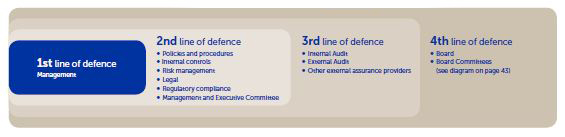
In relation to the Six Capitals Clover obtain external assurance against the respective capitals as described below:
| Capitals | Independent assurance providers: Clover’s 3rd line of defence | |
|
Manufactured Capital | |
 |
Natural Capital | |
 |
Human Capital | |
 |
Intellectual Capital | |
 |
Social and relationship Capital | |
 |
Financial Capital | |
 |
||
GRAPHIC IMAGE HERE
TA Wixley
Lead Independent Director