




How clover creates value and reporting on the six capitals
- How Clover creates value today
- Overview of Clover’s value creation process
- Reporting on the six capitals
- Clover’s business model
- Human capital
- Natural capital
- Manufactured capital
- Intellectual capital
- Social and relationship capital
- Financial capital
- How Clover sustains value for Tomorrow
- Clover’s future value creation philosophy
- Human capital
- Natural capital
- Manufactured capital
- Intellectual capital
- Social and relationship capital
- Combined Assurance
Manufactured Capital
How Clover creates value today: Manufactured Capital
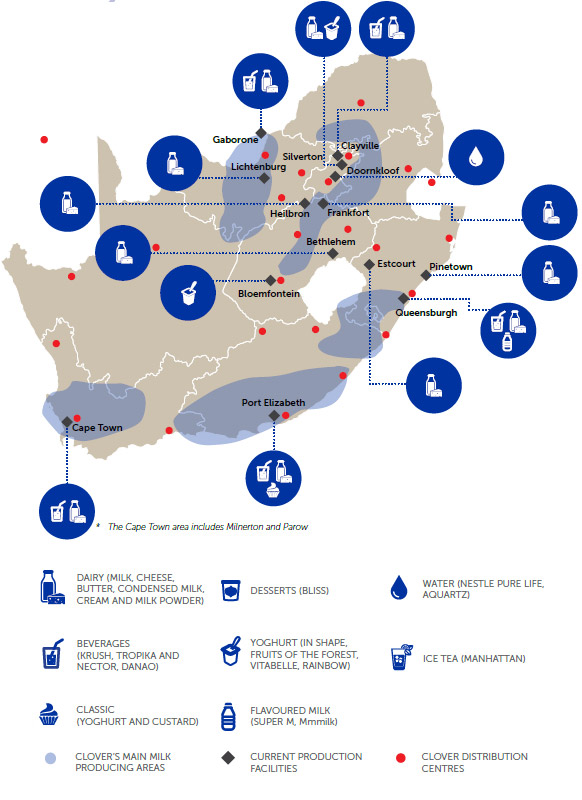
This table depicts salient features of Clover’s manufactured capital:
| PRODUCER SELECTION | As at 30 June 2017, Clover sources its milk from 145 carefully selected collection points. |
| ONGOING QUALITY ASSURANCE | 55 quality checks are performed on fresh milk from when it is collected at the farm to when it reaches the shelf. |
| CLOVER WAY BETTER APPROACH TO WORK | Clover’s production systems are flushed regularly to ensure freshness. |
| CLOVER WAY BETTER SUPPLY CHAIN AND WAREHOUSING CAPABILITIES | Delivering to approximately 30 887 points through 592 trucks to an average of 8 customers per day per truck. |
Supply Chain Planning and procurement
Clover’s Supply Chain Planning department centrally plans all manufacturing, purchasing, storing and deployment of finished goods throughout Clover’s integrated supply chain. Production requirements, stock levels and deployment plans are based on predicted future market demand for Clover’s products. Consumer demand is predicted through a sales and operations planning process that utilises statistical forecasting models. These results are further checked in collaboration with Clover’s Commercial and Clover Marketing divisions.
The Supply Chain Planning department is also responsible for managing all primary transportation between factories and distribution depots, as well as bulk deliveries to selected customers.
Clover’s centralised procurement department is responsible for procuring ingredients and packaging materials from qualifying suppliers to provide consistently high-quality materials for production. Clover’s procurement philosophy is to build partnerships that shift the understanding beyond monetary considerations to also include socio-economic objectives and long-term value creation.

Milk procurement
As a market-driven company, Clover sources its raw milk in volumes to match projected demand. Clover’s unique milk procurement system (CUMPS) is instrumental to helping ensure that Clover sources and retains raw milk accoring to its needs. Raw milk quality is the key to the safety and wholesomeness of Clover’s products. Clover regularly audits each and every farm where raw milk is produced and purchases all its milk from farms with above 80% audit scores against guidelines stipulated in Clover’s Best Farming Practices.
Production
Once the raw milk has passed all quality tests, it is processed at one of Clover’s 16 production facilities across South Africa and in certain African countries. Our products during the reporting period include fresh milk, UHT milk, flavoured milk, yoghurt, cheese, butter and milk powder, desserts, fruit juices, dairy fruit mix, water and iced tea. The base ingredient for our beverages is generally produced as a concentrate from carefully selected suppliers who guarantee consistently high-quality products. The concentrate is mixed with good quality water to manufacture final products such as Krush Juice and Tropika. Municipal and natural groundwater sources are regularly tested for safety and quality.
Clover owns the bulk of the properties from where we operate. Clover’s buildings and equipment are comprehensively insured, including for potential loss of profit due to business interruptions. New and innovative technologies are enabling Clover to consolidate some of our facilities for cost efficiencies. Clover continuously seeks ways and means to reduce costs along the supply chain to ensure that we remain cost competitive, while also lessening our environmental impact by reducing resource consumption.
Labour productivity increased substantially in the 2015/16 financial year, but reduced in 2016/2017, as volumes reduced substantially on certain production platforms. These platforms are being consolidated at present to ensure an improvement in average output per hour going forward. Clover is investing in automation for repetitive tasks, improved software and working methods to continue increasing productivity at the various Clover facilities.
Occupational Health and Safety
Clover has a responsibility to provide safe and healthy working environments. Formal health and safety policies are in place, and are monitored. Standard health and safety procedures exist for every potentially dangerous substance or operation in the workplace. All of Clover’s production facilities and distribution facilities were audited during the review period, for compliance with all applicable environmental legislation and the Occupational Health and Safety Act (OHS). Annual audits evaluate continuous health and safety improvement, supported by independent verification audits conducted every three years. Clover’s Lost Time Injury Frequency (LTIF) rate, based on reportable injuries per 200 000 man-hours worked, improved compared with the previous year. The table here aggregates current Clover health and safety statistics.
Quality
All Clover products are produced in terms of international best practices for quality, hygiene and food safety. These are only formally released by the Quality Control department once assessed against these specifications. All South African Clover factories are HACCP certified and accredited by third party auditors. We comply with all international standards required for food safety and quality risk management systems. Clover Quality Assurance and Control deploys highly trained technicians in well-equipped laboratories to test our products at all production stages.
Clover implemented the latest and world-wide accepted FSSC 22000 Quality Management system. Clover also introduced a Supplier Quality Control programme to ensure that all raw materials and packaging materials comply with internationally recognised food safety requirements.
Distribution
Clover’s Primary Distribution Department moves all our products from factories to distribution facilities across South Africa. Every day, our Customer Call Centre receives electronic or telephonic customer orders and arranges deliveries from one of Clover’s 26 distribution centres to approximately 30 887 delivery points in South Africa. Clover also has agreements with several major customers, for whom we provide distribution and in-store merchandising services.
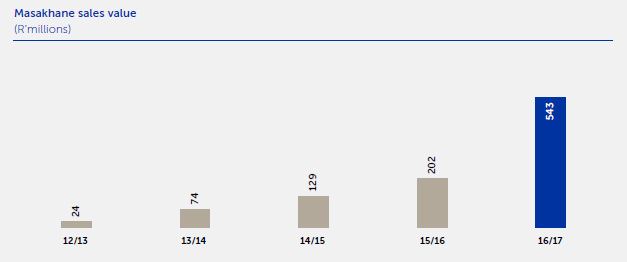
Masakhane – “Let’s build together”
Masakhane (literally meaning “Let’s build together”) got off the ground in 2012 as Clover’s first targeted approach to informal (emerging market) trading environments. The Masakhane objective is to grow the “emerging market” customer base and revenue stream by selling to stores that do not form part of a Clover Key Account or Buying Group. Masakhane has enabled Clover to rapidly increase our reach and footprint into informal and formal Food Service Industry (FSI) trading systems such as spaza shops, tuck shops, corner cafés, general traders, hotels, schools, B&B, restaurants and bottle stores.
Masakhane will create 1004 new and permanent jobs within the distribution and informal retail sector by reaching 61,603 customer stores by 2020. Masakhane recruits undergo sales, marketing and distribution training that equip Masakhane entrepreneurs with the ability to carry out their daily responsibilities, while preparing and developing them for formal trade. Furthermore, Masakhane provides training directly to the informal store owners to provide the required commercial and supply chain expertise to further develop and sustain their stores. Masakhane is a definite solution to the socio-economic problem of unemployment in South Africa and therefore is a catalyst for growth and job creation in the emerging market.
Masakhane’s initial 2012 customer base of 600 stores, has since expanded rapidly to 15,403 stores. Sales growth for the Masakhane channel over the last year was 168%.
The Maskahne sales channel has evolved from a strictly informal trade to now include the formal & informal FSI sales channel. The results have been so successful that Clover Masakhane has now expanded into the Swaziland and Namibia countries, where Clover has a sales and distribution infrastructure presence and “route to market” footprint.
- Factory machine availability
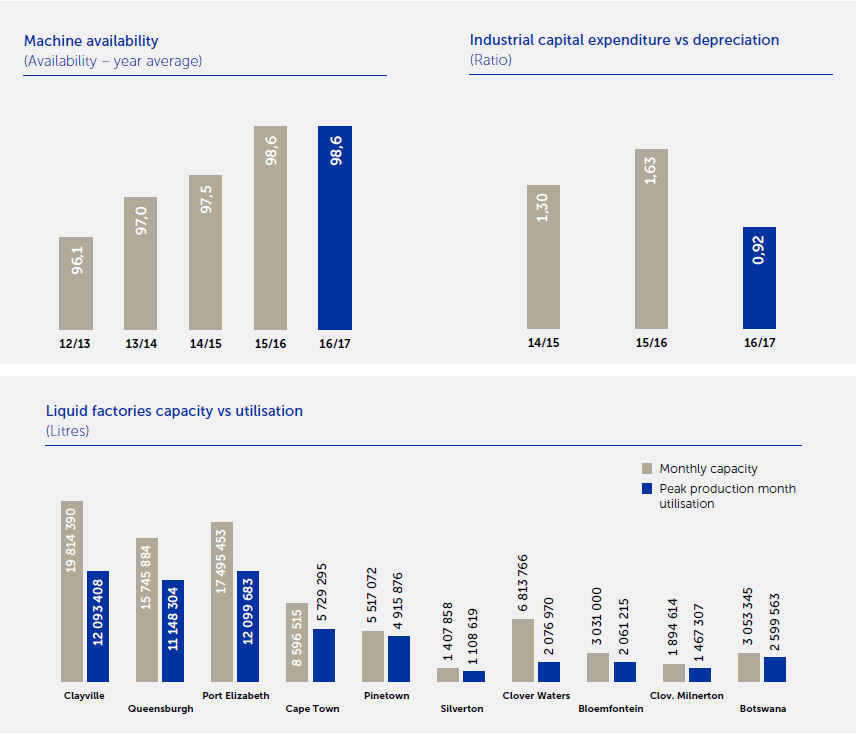
Maintaining a high level of machine availability is vital for achieving higher throughput per hour, reducing product losses and reducing energy consumption. A further benefit is that assets are properly utilised, and the need for additional equipment to accommodate a higher level of production is reduced when availability improves. Clover’s machine availability averages have increased substantially over the past five years.
- Depreciation vs Capital expenditure
The quality of Clover’s manufactured capital will deteriorate if we do not continually invest in it. Clover invests to improve efficiency and effectiveness rather than merely maintaining assets. In the first two years of the three year period shown, we allocated substantial capital resource into enhancing the quality of our manufacturing assets. During the past year, capital expenditure was limited to a strong focus on the maintenance, rather than the improving, of current capabilities. If maintained over the medium term, competitiveness would decrease. The graph below represents the capital investment for Clover’s production facilities.
- Capacity utilisation
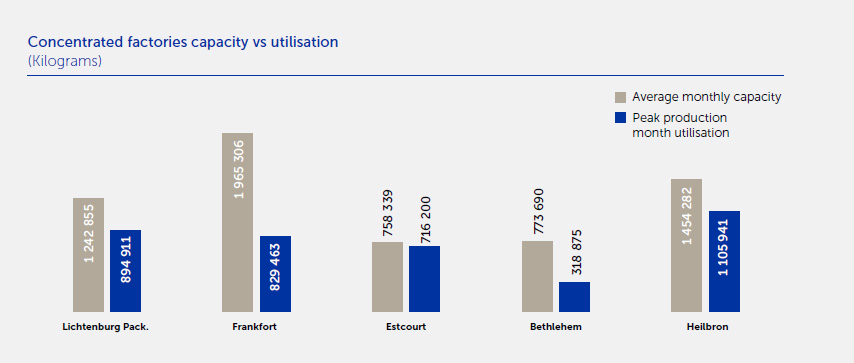
Sales growth is only possible if the manufacturing capacity exists to meet the higher volumes of production required. Clover’s ability to manage manufacturing capacities is vital for ramping up to meet unexpected demand, or to reduce production when needed to keep unit production costs down. Clover’s capacity utilisation per product group must remain within best practice parameters. Milk intake is seasonal, with an increased milk intake between August and January in any given year, so that certain factories work at full capacity in the seasonal peak cycle. Production reduces substantially in the off season. Clover’s capacity during the seasonal peak determines limits for increased milk intake. As some products are highly seasonal, the average value and the peak (October) value have been utilised as being the most illustrative.
Key Manufactured capital inputs
- State-of-the-art planning software being used by the Supply Chain Planning department.
- Substantial investment into production infrastructure in prior years.
- Clover’s extensive distribution network.
- Masakhane, which enables Clover to rapidly increase our reach into the informal trading market.
- Formal health and safety policies in place
Outputs
| 2017 | 2016 | |
| Capital Expenditure | 231,1m | 150,16m |
| Depreciation | 103,43m | 92,10m |
| Distribution Delivery Points | 30 887 | 20 545 |
| Informal stores serviced (Masakhane) | 17 678 | 9 801 |
Outcomes
- Clover is better prepared for long-term sustainability.
- Heightened customer service due to improved logistics and production.
| Supply chain | ||
| Description | 2016 | 2017 |
| Number of people receiving Health and Safety training (1 Person, 1 Course = 1) | 421 | 302 |
| Fatalities – People working under our control | 1 | 0 |
| Total Number of Recordable Injuries, including Medically Treated Cases, Lost Time Injuries and Fatalities | 610 | 824 |
| First Aid Cases – Persons working under our control | 566 | 779 |
| Reportable (Compensation Commissioner) lost time injuries for this financial year | 43 | 45 |
| Fatal Injury Frequency Rate (i.e. number of Fatalities per 200 000 person hours worked) | 0,011 | 0 |
| Lost Time Injury Frequency Rate (i.e. the number of LTIs per 200 000 person hours worked) | 0,5546 | 0,62712 |