

Chief executive’s report
 |
FINANCIAL PERFORMANCE |
Revenue increased by 8,6% to R9 266 million from R8 530 million in the prior year whilst operating profit increased significantly by 80,3% from R282,3 million to R509,1 million. |
 |
Johann Vorster |
The Group’s operating margin commensurately increased to 5,5%, up from 3,3% reported in the prior year and the 4,7% reported for the 2013 financial year. In addition, the recognition in a group subsidiary of a deferred tax asset not previously recognised, resulted in a reduction in the effective tax rate.
As a result, earnings per share increased by 86,1% to 190,4 cents and headline earnings per share of 173,6 cents was reported, an increase of 69,0% on the prior year’s 102,7 cents.
Clover’s Margin on Material (MoM) for the dairy fluids product group (consisting mostly of UHT and fresh milk, which also constitutes the bulk of raw milk usage) increased substantially following successful selling price increases. These increases however came at a loss in sales volumes and market share, especially in the aforementioned categories.
Additional sales volumes from Clover’s new yogurt and custard products, supplementary UHT production by its acquired Western Cape facility and the recently acquired Nkunzi MilkyWay business, however, brought about overall volume growth of 2,8% (overall sales volumes were equal to the prior year when concentrated products are converted to milk equivalent volumes rather than shown in kilograms) compared to the previous year.
Relatively high farm gate prices during the raw milk shortage experienced in the latter part of the previous financial year have resulted in a sharp increase in national milk production which continued during the peak production summer months.
The market was further stimulated at the time by a competitor paying above market prices in an attempt to secure raw milk supply. This lead to an unsustainable situation where supply far outstrips demand and the market will very likely experience an oversupply of raw milk in the current financial year.
As discussed in the Chairman’s Report, Clover strategically exited commoditised markets such as bulk cheese and milk powder. In addition, its unique milk procurement system (CUMPS) protects Clover against volume risk, since it balances raw milk intake against demand.
The Group will, however, invariably be impacted by overall downward pricing pressure in the market due to the oversupply, and subsequent margin erosion. Management will use all levers within their means to minimise any impact it might have.
To mitigate the situation as far as possible, Clover has already reduced the price it pays for raw milk and has withdrawn B quota contracts in consultation with farmers who have not exercised their option to produce in terms of these contracts.
MANUFACTURED CAPITAL
 The Group’s brand reputation provides for
relative price elasticity, allowing Clover to trade
at a premium to its competitors. The optimal
equilibrium between selling prices, volumes and market
share is unfortunately not an exact science and requires
careful consideration of a number of external factors to
ensure a sustainable, profitable business.
The Group’s brand reputation provides for
relative price elasticity, allowing Clover to trade
at a premium to its competitors. The optimal
equilibrium between selling prices, volumes and market
share is unfortunately not an exact science and requires
careful consideration of a number of external factors to
ensure a sustainable, profitable business.
As in 2010 with “Project Reset”, management and the board continuously monitors the trade-off between profit margins and volumes (reflected in overall market share) to maintain an ideal range.
The phased exit from the supply agreement with Danone resulted in a revenue loss of around R180 million. Vacant distribution capacity was partly taken up by some volume from Clover’s own product distribution, including yoghurt and custard, although there will be an anticipated lag before the entire vacancy has been utilised.
During the year under review, Clover successfully concluded an agreement with Dairybelle as a new principal to distribute and merchandise cheese and fruit juice on their behalf. Discussions with additional principals are ongoing.
The launch of “The Classic” range of premium smooth yoghurts, supported by the relaunch of “Fruits of the Forest” everyday yoghurt exceeded even the most optimistic expectations. Production at the acquired Bloemfontein plant which runs around the clock, seven days per week already reached maximum capacity.
Additional manufacturing lines have been ordered, the first of which is expected to be commissioned before December 2015 and the second towards March 2016.
During the year under review, Clover continued with its diversification strategy into value added dairy products with the launch of its premium range of desserts under the “Bliss” brand. Currently the range is imported from Italy and take-up has been in line with expectations. Once critical mass has been reached, consideration will be given to manufacturing the product locally.
The much anticipated launch of the “Futurelife” range of nutritious and convenient ‘smart drinks’ have been delayed due to manufacturing challenges. Clover is confident that the range will reach shelves during the current financial year.
Corporate activity
During the year under review, Clover acquired the Dairybelle UHT and yoghurt businesses with effect from 1 December 2014 and 1 January 2015 respectively. The aforementioned acquisition was approved by the Competition Tribunal on 28 November 2014, subject to certain conditions.
The Dairybelle acquisitions provided Clover with access into the highly attractive and profitable yoghurt market in which Dairybelle already enjoys a good brand presence. We also believe that combining their assets with the Group’s sales and distribution capabilities enabled us to develop the current Dairybelle brands and also provided Clover with the required capacity to launch Clover’s branded yoghurt products in this market.
On the UHT side, Dairybelle’ s business add significant scale to our market position, entrench our presence in the Western Cape and improve efficiencies through the more effective utilisation of raw milk supply in that region.
Clover further successfully acquired the business and assets of Nkunzi MilkyWay Proprietary Limited (“Nkunzi”). The acquisition has seen Clover entering the Ayrshire and organic milk markets, where it manufactures and packs fresh milk and cream in addition to other niche dairy and non-dairy products for Woolworths Holdings Limited (Woolworths).
The Ayrshire brand has grown tremendously over the past two decades as a result of substantial and ongoing investment by Woolworths. In addition to promoting the Ayrshire brand through continued high-quality dairy products, Clover will invest further in capital equipment and facility upgrades which will in part be driven by Woolworths’ 2020 growth strategy.
Clover has taken over the existing Nkunzi supply agreements with producers on the same terms and conditions, or renegotiated supply agreements on an individual basis with producers.
During the year the following projects were concluded:
| Clayville chilled warehouse expansion |
| Tropika 125/ 200ml UHT Prisma line installed |
| Queensburgh plastic UHT processing capacity expansion |
| Port Elizabeth fire protection |
| Port Elizabeth auto palletising |
| Bloemfontein yoghurt production facility upgrade |
| Clayville Futurelife product expansion |
| Parow/Stikland consolidation |
| Ixopo milk procurement depot expansion |
| Nestea relaunch |
| Manhattan Ice Tea relocation to Inhle |
 |
INTELLECTUAL CAPITAL |
All the market share and market growth
statistics discussed below are based on the
independent “Nielsen Total Trade Desk” data (“Nielsen
data”) which only comprises Shoprite Checkers,
Pick n Pay, Woolworths, Spar group and Fruit and Veg
City data. Wholesalers are excluded from these statistics
and Clover’s volume growth reported here may
therefore differ from Clover’s overall volume growth
reported elsewhere in the annual report. Kindly note
that the market statistics quoted in the 2013/14 annual
report was from Aztec which excluded Woolworths and Fruit and Veg City data. Clover has decided to rather use
Nielsen data going forward and all prior year statistics
have been restated accordingly.
The Nielsen data covers all sales in the abovementioned outlets for the year ending on 30 June 2015 and market shares are expressed as Clover’s sales for the year as a percentage of total market sales for the year. Therefore, where Clover introduced products during the year, the Nielsen market shares may be misleading.
Fresh and Ultra Pasteurised milk
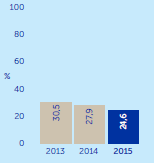
Clover’s market share by volume contracted 8,3% against the prior year, mainly as a result of high price increases implemented during the reporting period and high levels of national milk supply. The total market for fresh milk grew by 3,9% against the comparative year also reflecting the high levels of raw milk in the country. Clover’s market share for the year reduced from 27,9% to 24,6%.
UHT milk
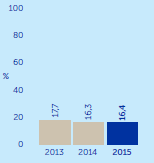
Continued aggressive pricing by retailer house brands resulted in overall total market volume growth of 2,3% albeit slower than the 8,7% market growth recorded in the prior year. The shortage experienced in the last quarter of the prior financial year curtailed Clover’s ability to retain market share during that year but during the current year Clover’s UHT volumes in the Nielsen channels grew by 3,3% assisted by the acquisition of the Dairybelle UHT business. As a result, Clover’s market share increased from 16,3% to 16,4% for the year. However, Clover only took over the Dairybelle UHT on 1 December 2014 and Clover’s market share of 19,5% for the month of June 2015 rather than the annual figure may therefore be more relevant.
Cream
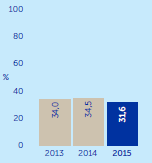
Total market volume growth was encouraging at 9,1% for the year under review. Clover’s market share however decreased by 2,9% to 31,6% largely as a result of less cream available to sell due to the lower fresh milk sales during the year.
Maas
Overall market volume growth of 3,0% was reported whilst Clover’s volumes grew by 14,0%. Clover continued making inroads into this segment, reporting market share growth of 0,8% and a market share of 8,1%.
Feta Cheese
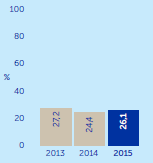
Clover grew its market share by volume by 1,7% to 26,1% on the back of a 11,9% volume growth compared to the 4,7% overall growth reported in the market segment.
Pure Juices
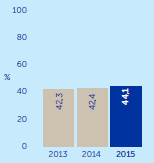
Overall volumes in the pure fruit juice market continued to decrease, reflective of reduced discretionary consumer spend. Despite a contraction of 9,5% in the overall market, Clover’s volumes declined by 5,8% which saw its market share increase by 1,7% to 44,1%.
Iced Tea – ready to drink
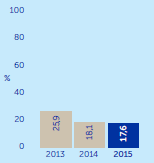
The ice tea category continued its strong growth, reporting a volume increase of 19,5% (Clover: 15,9%). Despite Clover’s healthy volume growth its market share in this competitive category declined by 0,5% to 17,6%. The market shares now shown include the volume of ice tea sold under the “Nestea” brand which was only launched in October 2014.
Dairy Fruit Mix
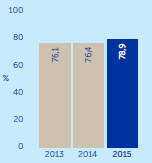
Volumes in the overall dairy fruit mix market continued to contract, albeit at a much slower rate of 0,6% for the year under review. Despite this decline, Clover continued to increase its market share through its popular “Tropika” and “Danao” brands by 2,5% to 78,9% and a 2,6% volume growth.
Bottled water
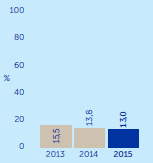
The total market volume in this segment increased by 12,9% during the year under review while Clover Waters’ market share in this segment however declined by 0,8% to 13,0% mainly as a result of strong competition.
Pre-packed cheese
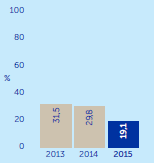
The overall volumes for natural pre-packed cheese grew by 16,5% during the year under review. Clover’s market share in this category contracted significantly from 29,8% to 19,1% due to:
- significant competition in the market as traditional bulk cheese volumes have been replaced by price competitive 800 or 900 gram bulk pre-packed cheeses;
- higher imports on the back of much lower international prices;
- the delisting of certain of Clover’s pre-packed cheese sku’s by a retailer early in the year;
- gouda cheese capacity constraints in Clover’s Lichtenburg factory; and
- Clover’s milk shortage during the winter of 2014 and resulting very low inventory levels at the start of this year.
Flavoured milk
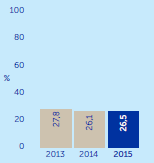
Despite a slight contraction in overall market volumes of 0,3%, Clover’s “Super M” brand increased its volumes by 1,5% and its market share by 0,4% to 26,5%.
Yoghurt
Clover entered the yoghurt category in January 2015 by introducing its own range of yoghurts under “The Classic” brand in addition to the manufacturing and distribution of the acquired and relaunched “Fruits of the Forest” brand.
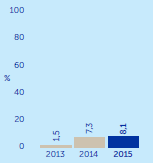
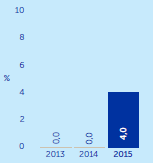
The total market volume grew by 3,8% during the year under review. Clovers market share for the whole year (although only participating in this category for half of the year) came to 4%. Its market share at June 2015 was, however, 9,2%.
Manufacturing capacity constraints at its Bloemfontein plant hampered market growth severely which should be addressed in the 2015/16 financial year once additional manufacturing capacity has been installed.
Custard
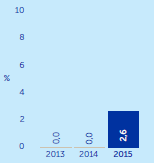
Similar to yoghurt Clover only entered the custard market in January 2015. Volumes in this market category grew by 11,9% and Clover’s share of this market’s annual sales volumes was 2,6%. The consumption of custard is highly seasonal (October to December are traditional high consumption months) and therefore the true market share of Clover’s newly launched “The Classic” in January 2015 will only be visible in the next financial year. The market share for June 2015 was 5,4% which might be the more relevant market share to take into consideration.
Butter
The total market volumes contracted by 1% as a result of low inventory levels at the start of the year due to the 2014 winter milk shortage.
Clover was able to grow its volumes by 6,5% and its market share in this constrained environment by 2,5% to 35,5% despite also not being able to fully supply the market during the early part of the year.
STAKEHOLDERS
Clover is cognisant of its responsibilities to all stakeholders to ensure long-term sustainability. The Group engages whenever relevant with its constituency through numerous channels of two-way communication to consider the impact that the business has on its stakeholders.
Recent discussions with dairy producers and organisations revolved around the production capability of the primary industry in South Africa and the challenge of finding supplementary markets to absorb this capacity. From our discussions, it is clear that volume is not an issue for dairy producers – but price is.
Herein lies the opportunity, provided that the entire industry commits to addressing the challenge.
Significant investment in dairy plants and technology in Africa has been practically non-existent over the past decade. In contrast, Fonterra – the world’s largest dairy exporter – has constructed several industrial parks with the latest technology to ensure economies of scale across the world – yet there is not a single similar facility on our continent.
To utilise the available volume of raw milk, the industry has to provide the export market with a sustainable supply of dry products with a longer shelf-life.
In order to attract the appropriate investments and latest technology, government and dairy farmers (including those who deliver to Clover and those who don’t) need to commit to a similar industrial park with economies of scale to compete effectively. This will require ongoing commitment, irrespective of the local dairy price, as sustainable exports depend on continuous supply.
From our discussions with government, the commitment to subsidise such an initiative appears to be there, provided that new job opportunities will be created and that emerging farmers will benefit from such a facility.
We will continue to engage with all role players on this important matter.
AFRICAN EXPANSION
The weakening of the Rand against major currencies had a positive impact on some of Clover’s foreign subsidiaries, most notably Botswana. Operations in that country performed well on larger volumes and was further buoyed by the exchange rate.
As mentioned in the previous report, local and immediate opportunities which became available following the termination of Clover’s restraint of trade with Danone Southern Africa took priority during the year under review.
To further facilitate its expansion into the continent, Clover successfully listed on the Namibian Stock Exchange. The listing will assist in building relationships with Namibian stakeholders and is important to the Group, especially considering its long-term strategic growth plans.
OUTLOOK: VALUE CREATION
Clover strongly believe that the secondary industry in South Africa is too fragmented, for a number of reasons. Consolidation will result in significant cost savings to the benefit of farmers and consumers. Too many manufacturers have their own supply chain, their own distribution, milk collection, merchandising, storage facilities, etc. with resultant huge inefficiencies in the secondary industry as a whole.
Clover cannot speak for the rest of the secondary industry but similar to the primary industry, it seems as though the secondary industry has also enjoyed decent trading conditions during the year under review. Milk production over the past eight months has, however, substantially outgrown market demand and together with UHT and other ready-to-use imports, are starting to manifest in a reduction in market prices (despite normal inflationary increases in non-milk costs). This will negatively affect the whole dairy industry for as long as milk production growth and market growth are not matched.
This unbalanced situation is not new nor is it unique. Through future consolidation several synergies can be unlocked that will reduce overall unit costs. Economies of scale will also result in the local industry protecting itself from international price fluctuations and cheap imports.
Clover will continue to investigate consolidation opportunities. In addition it will invest further in research and the development of new, differentiating products either through its in-house facility or in collaboration with industry counterparts.
The Group will further seek to maximise its relationship with the trade, leveraging and growing its extensive investment into IT systems. Clover continue to engage with retailers in this regard.
Clover is still focused on seeking various opportunities in the rest of Africa and its strategy in this regard is as follows:
- to grow Clover’s footprint in a number of African countries, Clover intends to take a minority stake in existing African businesses that offers infrastructure, brands, and route-to-markets;
- Clover will focus on small to medium size business that are scalable through bolting-on Clover’s existing basket. Clover will also provide expertise and resources to make these businesses more efficient throughout the value chain enhancements.
- forging partnerships with these existing businesses
will:
- be mutually beneficial;
- offer local market knowledge;
- create a platform to expand the operations to meet growing demand; and
- ensure benefits from economies of scale, and provide Clover with a low risk entry strategy
- While efficiencies are being realised and operations are being scaled up, Clover will progressively increase its stake in these businesses over time.
Clover is currently investigating various opportunities in Nigeria, Angola, Zambia, Tanzania, Kenya, Mozambique and Zimbabwe. During the year under review, Clover successfully established an export distribution model in Mozambique by partnering with a local reputable distributor. The renewed focus on the Mozambique market resulted in it being able to increase its 12 month accumulated sales to the trade in Mozambique from approximately R20 million to R140 million over a very short period.
This report would not be complete without reiterating Clover’s commitment to reducing its environmental footprint. These efforts not only include Clover’s own responsibilities but extends to its supply chain partners who, through their supply to Clover, have a significant environmental impact.
The Group will furthermore continue to focus on safety and health across all areas of the business.
|
HUMAN CAPITAL |
Appreciation |
I would like to thank the Board for their
commitment and active involvement in
plotting Clover’s long-term growth strategy
in an ever changing environment. A special thanks
goes to our Chairman, Mr Werner Büchner, for his
guidance throughout the year. Clover is very proud of
the partnership it has with its top quality milk producers
and on behalf of management, I’d like to extend a
sincere appreciation of their support and engagement
throughout the year.
As mentioned earlier, we continue to build on the solid relationship fostered with our supplier partners and thank you for the significant role you play in our sustainability and success.
I wish to thank all staff and their families for living the Clover brand and contributing to our success during the year. Much still needs to be done, but we can reflect on a successful year despite numerous challenges.
Lastly, a final word of thanks goes to my executive team for their hard work and unwavering commitment to doing it “Way Better” throughout the year. I sincerely thank you for your support.
For more information, refer to the Integrated Annual Report as well as the Report on the Six Capitals on www.clover.co.za.

Johann Vorster
Chief Executive
15 September 2015
Market share
.
| FRESH AND UP MILK | UHT MILK | CREAM | FETA CHEESE | |||
 |
 |
 |
 |
|||
| PRE PACKED CHEESE | PURE FRESH JUICES | WATER BRANDS | FLAVOURED MILK | |||
 |
 |
 |
 |
|||
| DAIRY FRUIT MIX | ICED TEA | MAAS | PROCESSED CHEESE SLICES |
|||
 |
 |
 |
 |
|||
| LIQUID CUSTARD | YOGHURT | |||||
 |
 |