
six capital REPORT
overview
Clover’s Vision and Mission has been aligned to the value chain, and the company appreciates that strategy, risk, governance, performance and sustainability are inseparable. While the report has been structured to incorporate both the requirements of the Companies Act 71 of 2008 (Regulation 43), as well as the King Report on Governance in South Africa 2009 ("King III"). Clover has also adopted the latest Integrated Reporting Framework as issued by the International Integrated Reporting Council ("IIRC") in 2013.
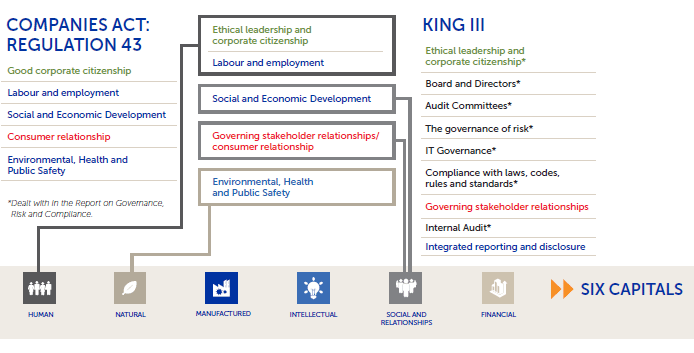
This framework follows a principle based approach in which Clover describes the key components of its value chain (business model) it applied to create and sustain value for its stakeholders, since the company’s incorporation. This report is structured in accordance with the concept of the six capitals which takes into consideration the material inputs and resources required for Clover to create and sustain value in the long term. Clover’s value creation story takes into account the requirements of both Regulation 43 and King III, which are incorporated into the six capitals as diagrammatically depicted below:
Scope and Boundary
The scope of this report covers Clover’s South African operations and will over time be extended to its subsidiaries in other countries. The report also deals with the most relevant and material issues that could substantially impact on Clover’s ability to create and sustain value for its stakeholders in the long term.
Clover is one of a few South African businesses that have been in existence for well over 100 years, and we recognise that in order to survive and prosper, we need to be concerned with sustainability.
The Social and Ethics committee is chaired by the Lead Independent Director of the Board and consists of a further two Independent Directors and one Executive Director. Details of the members of the Social and Ethics Committee and the number of meetings (including the attendance of the members) held for the financial year are set out here and here in the Report on Governance, Risk and Compliance.
The Social and Ethics Committee has considered the matters of the Integrated Annual Report that are pertinent to Clover. The responsibilities and functioning of the Social and Ethics Committee (“Committee”) are governed by formal terms of reference approved by the Board and is subject to regular review. The main objective of the Committee is to assist the Board in ensuring that Clover remains a responsible corporate citizen with sustainable business practices by monitoring, developing, reviewing and enhancing the Group’s social, ethical, environmental impact and governance in terms of Regulation 43 of the Act, and King III. To accomplish these above-mentioned tasks, the Social and Ethics Committee has developed and adopted a formal work plan entailing the functions as set out in Regulation 43 of the Companies Act and King III. The implementation of this work plan is prioritised to enable Clover to fully discharge its statutory functions over a period of three years. The Board supports the Committee by setting the appropriate tone at the top, and Clover’s Way Better philosophy across the organisation contributes to Clover’s ethical culture. This report describes the work and conclusions of the Committee in its fourth year of establishment. Over and above the requirements of the Act, the scope of the report has also taken into consideration the guidelines to the Integrated Reporting Framework and the fourth edition of the Sustainability Reporting Guidelines of the Global Reporting Initiative. In short, through the six capitals, the key aspects of Clover’s business that are critical to its long-term value creation are summarised hereafter.
 Annually, Clover defines its risk bearing capacity and
risk appetite, being the basis of setting materiality levels.
These materiality levels are used to annually adjust
thresholds of Clover’s delegation of authority, ensuring
that appropriate limits of managerial approval are
set. These same materiality levels are used in Clover’s
Enterprise Wide Risk Management Framework, which
ultimately ensures that all material risks are reported
to the Board Committees and considered for inclusion
in Clover’s Integrated Annual Report. For purposes of
compiling this Integrated Annual Report, Clover is only
reporting on issues it believes to be material.
Annually, Clover defines its risk bearing capacity and
risk appetite, being the basis of setting materiality levels.
These materiality levels are used to annually adjust
thresholds of Clover’s delegation of authority, ensuring
that appropriate limits of managerial approval are
set. These same materiality levels are used in Clover’s
Enterprise Wide Risk Management Framework, which
ultimately ensures that all material risks are reported
to the Board Committees and considered for inclusion
in Clover’s Integrated Annual Report. For purposes of
compiling this Integrated Annual Report, Clover is only
reporting on issues it believes to be material.
Clover and its leaders have adopted a philosophy that respects the rights and dignity of others. At Clover we are aware of how our decisions influence others, and these principles are integrated in our thinking and decision making processes. Our ethical leadership principles are an integral part of our vision and mission, and are demonstrated by our people through the execution of their functions and projects. Effective leadership based on an ethical foundation Clover’s strategy to build a sustainable business considers the long and short-term impacts of our operations on the economy, society and the environment. It is our intention not to compromise the environment, and we consider the impact of our operations on both internal and external stakeholders. Promotion of equality, prevention of unfair discrimination and reduction of corruption Clover is committed to the promotion of equality, and prevention of unfair discrimination with all its stakeholders, as is demonstrated in the Clover Ethics policy. We are committed to using our best endeavours to adhere to the following principles:
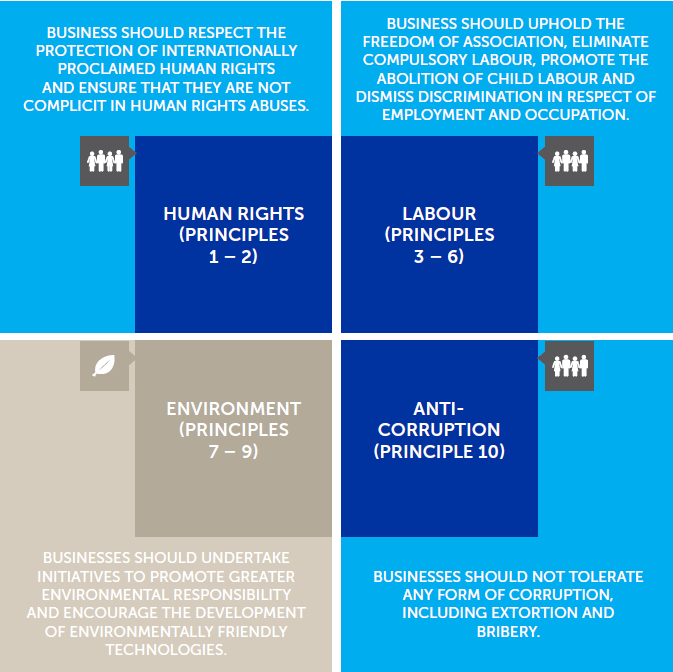
- The United Nations Global Compact principles;
- The Organisation for Economic Co-operation and Development (“OECD”) principles on corruption; and
- International Labour Office (“ILO”).
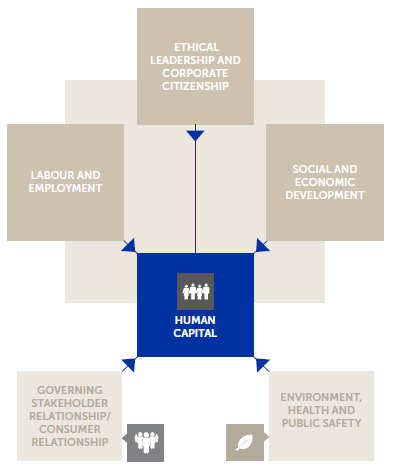
Regulation 43 of Companies Act of 2008
 |
Environment, health and public safety are dealt with under the Natural Capital. |
 |
Governing stakeholder relationship/consumer relationship dealt with under the Social and Relationship Capital. |
The OECD recommendations on corruption
Clover is committed to conducting its business activities lawfully and in a manner that will enhance the qualities valued by Clover, in particular, ethics, integrity and compliance with the law. Corruption can occur in many forms including extortion, nepotism, embezzlement, bribery, cronyism, patronage amongst others. Corruption impacts directly or indirectly on sustainable development of Clover’s stakeholders. Clover’s business processes, employee behaviour and daily activities at all levels of the organisation are conducted in accordance with the OECD recommendations on corruption. Further disclosure on the combatting of corruption can be found in our reports on Risk Governance and Compliance. In order to ensure compliance to these principles, Clover’s Human Resources function and Risk Department conduct annual evaluations of the Group’s performance. Based on the evaluations performed for the year under review, no material deviations were reported.
Our Ethical Leadership principles dealing with corruption are further disclosed in our Report on Governance, Risk and Compliance. Ongoing awareness is raised through Clover’s ethics awareness campaigns at all operations for purposes of enforcing Clover’s ethical principles. Clover has formalised its ethical values into its Ethics policy, which is available on Clover’s website.