

Natural capital
 The growing demand for natural resources will force
dairy companies to process products more efficiently
by lowering its carbon and water footprint by making
use of the latest technologies available globally. In
addressing its dispersed factory locations, Clover is
evaluating its options to consolidate these factories
and install latest technology, enabling it to improve its
cost competitiveness, while also achieving synergies
in sustainability of its operations, such as reduction
in Clover’s carbon and water footprint. As some of
the technologies are expensive, Clover is constantly
reviewing available government tax incentives and
grants for improved energy and water efficiencies.
This will allow Clover to be more cost competitive at
a unit cost level. Clover is reliant on a constant good
quality water source to ensure that products meet its
minimum quality standards. In areas where water quality
is inconsistent, Clover installs water purification/filtration
systems to ensure a quality water supply to the factory.
Clover is exposed to areas where factories are located
in water scarce areas, as no factory can be operational
without water supply which is required to clean
manufacturing lines on completion of production batch
runs or where water is used as a base of the product,
such as juice. Future climate change may also impact
on milk supply areas and available supply.
The growing demand for natural resources will force
dairy companies to process products more efficiently
by lowering its carbon and water footprint by making
use of the latest technologies available globally. In
addressing its dispersed factory locations, Clover is
evaluating its options to consolidate these factories
and install latest technology, enabling it to improve its
cost competitiveness, while also achieving synergies
in sustainability of its operations, such as reduction
in Clover’s carbon and water footprint. As some of
the technologies are expensive, Clover is constantly
reviewing available government tax incentives and
grants for improved energy and water efficiencies.
This will allow Clover to be more cost competitive at
a unit cost level. Clover is reliant on a constant good
quality water source to ensure that products meet its
minimum quality standards. In areas where water quality
is inconsistent, Clover installs water purification/filtration
systems to ensure a quality water supply to the factory.
Clover is exposed to areas where factories are located
in water scarce areas, as no factory can be operational
without water supply which is required to clean
manufacturing lines on completion of production batch
runs or where water is used as a base of the product,
such as juice. Future climate change may also impact
on milk supply areas and available supply.
Clover is a branded food and beverages group with a strong emphasis on value-added products. The company has operations in South Africa and selected African countries. Part of the company’s vision is to deliver trusted products and sustainable shareholder value by being a responsible corporate citizen and preferred employer.
As part of achieving this vision, Clover recognises its responsibility to reduce, and as far as practical, to eliminate the impacts of its business on the environment. This responsibility relates not only to operations within Clover’s control, but also to Clover’s supply chain partners, which are recognised to be responsible for significant environmental impacts in supplying Clover.
In realisation of this responsibility, Clover is committed to implementing and maintaining an effective Environmental Management System to provide a structured framework for continual improvement of its environmental performance. As part of the Clover Environmental Management System, Clover has set the following objectives which have also been incorporated into Clover’s Environmental Policy:
| Objective | Outcome |
| Continuously improve environmental performance. | Implement and maintain an effective environmental management system (“EMS”). Provide a structured framework for continual improvement. Identify and manage progress against set targets per identified aspects. |
| Inform staff on the EMS and policy and equip them with skills to achieve requirements of the Policy. | Staff engagement, formal development and training. |
| Ensure consistent quality of products in line with legal, regulatory and best practise requirements. | Implement quality assurance models in both Clover’s milk collection as well as the production environments with laboratories monitoring and testing quality of products. Ultimately quality is monitored through feedback at Clover’s Consumer Centre handling general enquiries, complaints as well as compliments. |
| Reduce carbon footprint. | Quantify the carbon footprint associated with operations and key elements of the supply chain. Set annual targets for reducing Clover’s overall climate impact. |
| Reduce water usage across operations. | Monitor water usage and set targets for reducing water consumption. |
| Limit the generation of solid and liquid waste and the impact of their disposal on the environment. | Implement programme, monitor waste sent to landfill and set targets for reducing waste to landfill. |
| Minimise product returns and damages and the impact thereof on the environment. | Implement programmes to continuously reduce returns. |
| Reduce energy consumption and associated emissions. | Monitor energy usage and set targets for reducing consumption. |
| Manage impacts for on-site storage of fuels and chemicals, both during normal operation and in the event of spills and emergencies. | Implementation and monitoring of procedures. |
| Optimise the use of primary and secondary packaging. | Monitor wastage and implement improvement processes and targets. |
| Adhere to all applicable environmental legislation. | Continuously review and revise the ambit and effectiveness of the EMS. |
| Ensure continuous monitoring of and reduction in the impacts associated with milk supply. | Support and development of the Best Farming Practices Programme. |
| Inform supply chain partners on activities to reduce environmental impact and partner with them to reduce their own impact. | Formally engage with partners in the supply chain. |
| Ensure Health and Safety throughout all operations. | Continuous monitoring to ensure safe working environment. |
Environmental
Clover strives to manage its business in such a manner that the environment is adequately protected, the use of natural resources is minimised, and that environmental management programmes are established to contribute towards the sustainability objectives of the company. Clover’s green initiative strategy was formalised and commenced in the 2011 financial year with the aim of establishing a formal environmental sustainability (“green”) strategy. In terms of achieving this vision, Clover recognises its responsibility to reduce, and as far as possible, to eliminate the impact of its business on the environment. Clover recognises that in achieving environmental excellence, it would obtain a competitive advantage over its peers, as a food manufacturer’s energy and services costs comprise approximately 17% of fixed costs.
This responsibility not only relates to operations within Clover’s control, but also to Clover’s supply chain partners, who in the course of supplying Clover, could be responsible for significant environmental impacts. In the realisation of this responsibility, Clover has developed an environmental management system (“EMS”) which provides a structured framework against which continuous improvement can be measured. Clover actively monitors environmental, health, safety and quality through the use of its dedicated Entropy SHEQ management system and other forms of assurance.
The Social and Ethics Committee requires each business unit to regularly report its impact on the environment based on agreed measures. The Chief Engineer: Maintenance and Safety, Health and Environment (“SHE”) for production together with the Divisional Engineer for distribution are both responsible for reporting on Clover’s green strategy and on the SHE compliance to the Social and Ethics Committee.
Operational efficiency| 2012/2013 | 2013/2014 | 2014/2015 | |
| Total Direct Energy Consumption in Gigajoules – i.e. from fuels burned | 1 514 881 | 1 445 980 | 1 514 773 |
|---|---|---|---|
| Total Indirect Energy Consumption in Gigajoules – i.e. from electricity consumed | 526 292 | 474 801 | 482 168 |
| Total Electricity Consumption (MWh) | 146 192 | 131 889 | 133 936 |
| Total Energy Consumption in Gigajoules | *** | *** | 1 966 941 |
| Electricity consumed per kg product produced (kWh/ton) | 168,4 | 142,4 | 137,3 |
| Fuel consumed for steam generation (coal, diesel, HFO) per kg product produced (kWh eq/ton) | 523 | 423 | 402 |
| Waste to landfill in kg per ton produced | 15 | 9,3 | 7,3 |
| Total weight of Non-Hazardous Waste Disposed (ton) | *** | *** | 5 940 |
| Total weight of Hazardous Waste Disposed (ton) | *** | *** | 758 |
| Total weight of Waste sent for Recycling (ton)**** | 8 552 | ||
| Percentage of Waste disposed of that is sent for recycling | 52 | 58 | 71 |
| Water consumed per kg of product produced* | 4,56 | 4,09 | 3,79 |
| Total Water Consumption (Kilolitres/Kl)***** | 3 100 616 | 3 363 183 | 3 323 214 |
| Average Volume of Water (Litres) Consumed per Person Hour Worked (l/HW) | *** | *** | 283 614 |
| Carbon Footprint ** | |||
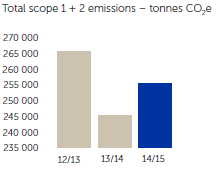
| Total Carbon Emissions (Tons of Carbon Dioxide equivalents, CO2e) | 265 627 | 245 357 | 255 482 |
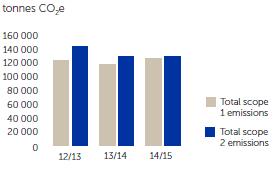
| Total Scope 1 emissions (tonnes CO2 eq) | 122 765 | 116 659 | 125 887 |
| Total Scope 2 emissions (tonnes CO2 eq) | 142 862 | 128 698 | 129 595 |
| Average Volume of Carbon Emissions per Person Hour Worked | |||
| (Tons CO2e/HW) | *** | *** | 0,022 |
| Trends per Source | |||
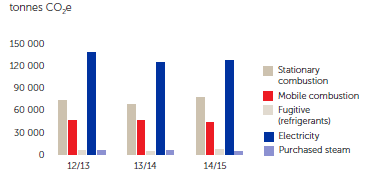
| Stationary combustion (tonnes CO2 eq) | 72 827 | 67 304 | 76 495 |
| Mobile combustion (tonnes CO2 eq) | 44 956 | 45 595 | 43 027 |
| Fugitive (refrigerants) (tonnes CO2 eq) | 4 982 | 3 759 | 6 365 |
| Electricity (tonnes CO2 eq) | 137 397 | 123 955 | 125 878 |
| Purchased steam (tonnes CO2 eq) | 5 465 | 4 744 | 3 717 |
| * | Please note that water consumption is only reported for production, however production constitutes 95% of all Clover’s water usage. |
| ** | Data in respect of carbon footprint include all entities acquired during the year. |
| *** | Data for this period is unavailable. Data for the 2014/2015 period will be used as a base for future reporting periods. |
| *** | Please note: for the 2013/2014 year the figures relate to production only and for 2014/2015 year, includes the entire supply chain. |
| *** | Please note this relates to production only. |
Carbon footprint
Clover’s carbon footprint extends over the operations of the following five business units:
| Business unit | Description/key activity |
| Head Office | Corporate administration, marketing, management. |
| Procurement | Transportation of raw milk and materials from suppliers to Clover facilities. |
| Production | Facilities for the processing, packaging and dispatching of products. |
| Primary Distribution | Transport of products from production facilities to primary and secondary distribution centres. |
| Secondary Distribution | Clover controls a large number of secondary distribution facilities across South Africa that handles own and principal clients’ products. Distribution is to retail customers through leased vehicles, under the control of Clover. |
|

| CARBON FOOTPRINT | CARBON FOOTPRINT– BY SCOPE | |
 |
 |
| CARBON FOOTPRINT |
 |
Value creation
Past
 Behaviour in the company is strongly driven by financial
and legal imperatives. Particular emphasis where placed
on ensuring correct invoicing from service providers,
and ensuring that no under/over billing occurs for critical
inputs, for example, fuel, water and electricity. Fuel and
water quality was a strong focus area. Compliance with
legislation was emphasised.
Behaviour in the company is strongly driven by financial
and legal imperatives. Particular emphasis where placed
on ensuring correct invoicing from service providers,
and ensuring that no under/over billing occurs for critical
inputs, for example, fuel, water and electricity. Fuel and
water quality was a strong focus area. Compliance with
legislation was emphasised.
Present
The significant change in relative pricing for energy and other utilities has had (and continuous to have) a significant impact on the company. Relative pricing has changed to such an extent, that a failure to reduce resource consumption intensity will diminish the competiveness of the company, impacting directly on long term value creation. This is especially true in the case of water, electricity and fuels. This structural change has also created an opportunity to improve resource use efficiency, as the company has a responsibility towards all stakeholders to use limited resources wisely for future value creation. This responsibility to all stakeholders also extends to continuously reducing our impact on the environment over time. Given the above, Clover has placed significant emphasis on reducing resource consumption intensity, and aligning actions and activities with performance appraisal and targets. During the current year, our continued focus on water, air and fuel quality has been further improved.
Future
South Africa faces significant water and electricity constraints at present, which necessitates an extended period of capital expenditure. There will be significant pressure to increase tariffs to recover capital expenditure. We anticipate that tariffs will need to increase above the average rate of inflation for an extended period of time. We have therefore embarked on a journey of continuous efficiency improvements to reduce resource consumption.
In order to achieve this, the company will partner with selective service providers to ensure economies of scale in the use of new technologies, and to ensure that Clover becomes the efficiency leader in the market segments it competes in. This not only extends to improved efficiency in terms of water, electricity and fuel consumption, but also to eliminate waste to landfill, effluent under the control of the company, and all other environmental impacts across the value chain.
Clover makes use of available grants and tax allowances to implement “Green technology’’ reducing its carbon and water footprint to improve its operations to be more sustainable in future. This will also result in the reduction of Clover’s cost to produce that will enhance long term value creation.
At Clover our end goal is to create long term value through being a good corporate citizen that improves the wellbeing of all our stakeholders.