

Report on governance, risk and compliance
Click here to view larger image
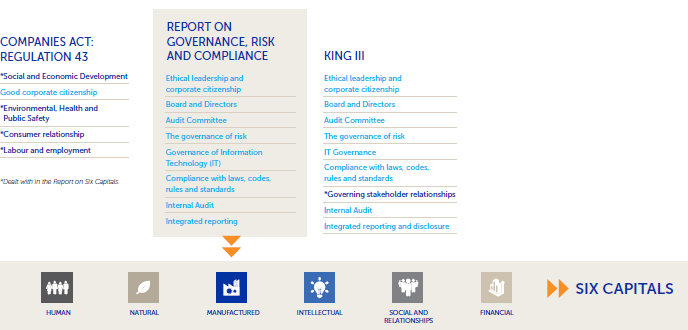
Responsibility to ensure
good governance
Good corporate governance underpins transparency, fairness, integrity and accountability in Clover’s daily interactions with all stakeholders and the environment. The underlying objective of governance is to counterbalance the interests of investors, consumers, producers, the environment, employees, communities, government and any other groups impacted by Clover’s business, safeguarding its sustainability.
Statement of compliance
The Board endorses the King Code of Governance Principles for South Africa 2009 (“King III” or “the Code”) and has satisfied itself that Clover has conformed throughout the reporting period to all the principles of the Code and the Listings Requirements of the JSE with limited exceptions. Where Clover has partially complied or not complied with these provisions, the Group has provided motivations and reasons, as indicated in the King III index here in this report.
The Internal Auditors conducted an audit review to assess the governance infrastructure and processes that executive management has established. Deloitte found the internal controls over all operations of the corporate governance process and related activities, to be adequate and effective, and further found the governance practices to be mature.
The table below indicates management’s conclusions on Clover's governance process
| Review area | Conclusion regarding adequacy |
Conclusion regarding effectiveness |
| Ethical Leadership and Corporate Citizenship | Adequate | Effective |
| Boards and Directors | Adequate | Effective |
| Audit & Risk Committee | Adequate | Effective |
| The Governance of Risk | Adequate | Effective |
| The Governance of Information Technology | Adequate | Effective |
| Compliance with Laws, Codes, Rules and Standards | Adequate | Effective |
| Internal Audit | Adequate | Effective |
| Governing Stakeholder Relationships | Adequate | Effective |
| Integrated Reporting and Disclosure | Adequate | Effective |
Ethical leadership and corporate citizenship
The Board has adopted a Code of Ethics which is continuously reviewed and updated as required. This Code defines Clover’s main ethical standards of responsibility, integrity, fairness, accountability and respect. These ethical standards also form the basis of the Chief Executive’s Report. The Code contains examples of unethical conduct and disclosure requirements in respect of gifts and outside interests requiring pre-approval. To ensure that Cloverites are consistently aware of the importance of ethical behaviour, ethics awareness sessions are hosted at branch level in an attempt to explain Clover’s Ethics Hotline, when it should be used and how. This code is used as a benchmark against which to manage the business, taking into consideration the social, political and operational environments in which the business conducts itself.
As an iconic brand operating within the branded consumer goods industry, Clover is aware of the importance of its reputation and protects this.
During the reporting period, no material ethical leadership or corporate citizenship deficiencies were noted. The Board is responsible for Clover’s compliance with the Code of Ethics. It has delegated the responsibility of oversight and monitoring to the Audit and Risk Committee as well as the Social and Ethics Committee, which are both sub-committees of the Board. These committees monitor and measure compliance through various reporting channels, such as:
- its Internal Audit department, outsourced to Deloitte;
- the Ethics Hotline; and
- Clover’s Competition Law Centre of Excellence.
No requests for information in terms of the Promotion of Access to Information Act were received during the reporting period. Clover complied in all material aspects with all relevant legislation and was not subject to any material penalties, fines or criminal procedures.
Board and directors
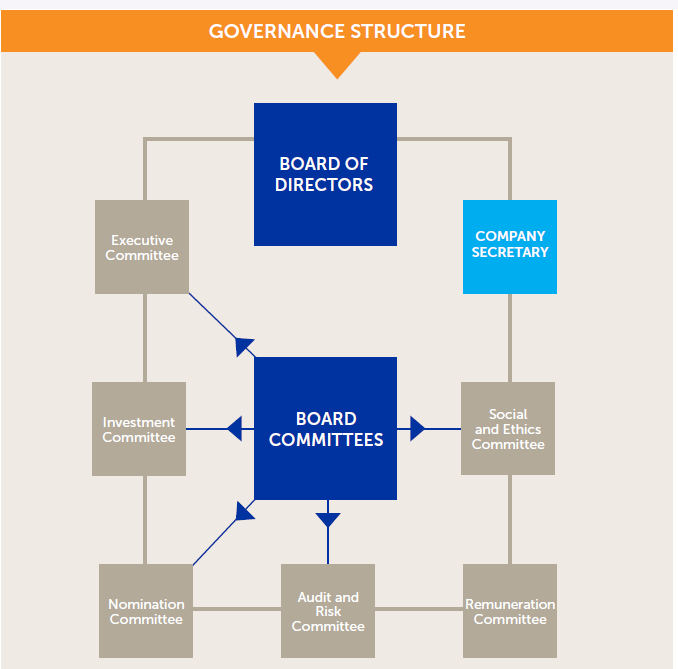
The Board is ultimately responsible for effective corporate governance.
The Board’s responsibilities are formalised in a charter, which is reviewed on an annual basis. All Board sub-committees operate under Board approved mandates and terms of reference. Save for the Executive Committee, all other committees are chaired by Independent Non-executive Directors.
The Board
The Board is accountable to shareholders and ultimately responsible for the management of Clover’s business, including determining strategies and policies. The Board is also responsible for approving the Group’s financial objectives and targets.
Although members of the Board are appointed by the Company’s shareholders, the Board has the authority to appoint directors to fill any vacancy that may arise from time to time. These appointments are ratified by shareholders at the subsequent Annual General Meeting.
Directors are appointed based on their specific skills set, industry expertise and experience as well as the overall level of contribution they can make to the activities of the Group. The Nomination Committee, as a sub-committee of the Board, has been tasked with identifying and recommending suitable candidates for the Board’s consideration through a formal process. Cognisance is taken of the Group’s overall empowerment and transformation drives in this regard.
New appointees are appropriately familiarised with the Group’s business through a formal induction programme.
The day-to-day business activities of the Company are the responsibilities of the Executive Committee. This Committee is responsible for ensuring that Board decisions are effectively implemented in line with its mandates.
Clover’s Memorandum of Incorporation gives the Board the authority to indemnify directors. Deeds of indemnification have been issued to all directors and prescribed officers of Clover, to the extent permitted by the Companies Act. During the reporting period, appropriate directors’ and officers’ liability insurance was in place.
| Director | Board | Audit and Risk Committee | Remuneration Committee | Nomination Committee | Social and Ethics Committee | Investment Committee | ||||||
| Independent non-executive | A | B | A | B | A | B | A | B | A | B | A | B |
|---|---|---|---|---|---|---|---|---|---|---|---|---|
| TA Wixley | 5 | 5 | 4 | 4 | 4 | 3 | 1 | 1 | 4 | 4 | 2 | 2 |
| Dr. SF Booysen | 5 | 4 | 4 | 4 | 4 | 4 | 1 | 1 | 4 | 4 | 2 | 2 |
| JNS du Plessis | 5 | 5 | 4 | 4 | 4 | 4 | ||||||
| NV Mokhesi | 5 | 5 | 4 | 4 | ||||||||
| B Ngonyama | 5 | 5 | 4 | 4 | ||||||||
| Non-executive | ||||||||||||
| WI Büchner | 5 | 5 | 4 | 4 | 1 | 1 | 2 | 2 | ||||
| NA Smith | 5 | 5 | 2 | 2 | ||||||||
| PR Griffin | 5 | 5 | ||||||||||
| Executive | ||||||||||||
| JH Vorster | 5 | 5 | ||||||||||
| LJ Botha | 5 | 5 | ||||||||||
| Dr. CP Lerm | 5 | 4 | ||||||||||
| A | Number of meetings held during the period the Director was a member of the Board/Committee |
| B | Number of meetings attended during the period the Director was a member of the Board/Committee |
Company Secretary
The Company Secretary is responsible to the Board for ensuring that procedures and regulations are complied with and that Directors are conversant with their duties and responsibilities. The Directors of the Group have unfettered access to the advice and services of the Company Secretary and may seek independent professional advice on the affairs of the Group in appropriate circumstances if they believe that such actions will best serve the interests of the Group. Having duly considered the above, the Board is comfortable that the Company Secretary maintains an arm’s length relationship with the Board and individual directors in terms of Section 3.84(j) of the JSE Listings Requirements. The Certificate of Jacques van Heerden, the Company Secretary, appears here in this Integrated Annual Report.
Board Committees
The Board has mandated a number of sub-committees to assist it in discharging its responsibilities. Each subcommittee’s scope and nature of authority is stipulated in its terms of reference, which is approved by the Board. Clover’s Audit and Risk Committee as well as its Social and Ethics Committee have certain specific responsibilities in terms of the Companies Act and its Regulations. Copies of the respective terms of reference are available at www.clover.co.za.
Executive Committee
ER Bosch
Dr. JHF Botes
LJ Botha
Dr. CP Lerm
H Lubbe
MM Palmeiro
J van Heerden
JH Vorster – Chairman
Directors, executives and operational management have clearly defined responsibilities and levels of authorisation for their respective areas of the business. The delegation of these responsibilities is reviewed annually.
The Executive Committee reviews and identifies risk, current operations and the management thereof. This Committee is tasked with developing strategies and recommending policies for the Board’s consideration as well as the implementation of the Board’s directives and decisions.
Audit and Risk Committee
Dr. SF Booysen
JNS du Plessis
B Ngonyama
TA Wixley – Chairman
The Audit and Risk Committee comprises only Independent Non-executive Directors. The CEO, CFO as well as other Executive and Non-executive Directors attend meetings of the Audit and Risk Committee by invitation.
The report of the Audit and Risk Committee is available here in this report and sets out the responsibilities and delivery of the Committee against these objectives during the review period.
Remuneration Committee
Dr. SF Booysen – Chairman
WI Büchner
JNS du Plessis
TA Wixley
The Chief Executive and other executives attend meetings of the Remuneration Committee as invitees and are recused from discussions pertaining to their own remuneration and benefits. The report of the Remuneration Committee is here and sets out its responsibilities as well as its delivery against these.
Social and Ethics Committee
SF Booysen
ER Bosch
N Mokhesi
TA Wixley – Chairman
The mandate of this Committee is specified in Regulation 43(5) of the Companies Act. Its responsibilities and functions are governed by terms of reference which are regularly reviewed and approved by the Board. As sub-committee of the Board, the Social and Ethics Committee is tasked with the monitoring, developing, reviewing and improvement of Clover’s social, ethical, environmental impact and governance policies against pre-set benchmarks. In terms of the Committee’s work plan, the implementation of certain actions have been prioritised to enable it to fully discharge its statutory functions over a three year period. This Committee meets four times per year and reports through one of its members to shareholders at the Company’s Annual General Meeting on all sustainable matters within its mandate. Its Report on Six Capitals is available on www.clover.co.za as well as on here of this report.
Nomination Committee
Dr. SF Booysen – Chairman
WI Büchner
TA Wixley
The Nomination Committee is tasked with the regular review of the Board’s structure, size and composition and with making recommendations in this regard, taking cognisance of the Company’s strategies and operating environments. Appointments to the Board will be formal and transparent and will be considered by the Board as a whole, following nominations received from the committee. The Committee is furthermore responsible to ensure that an appropriate balance exists between Executive, Non-executive and Independent Non-executive Directors, as well as for the classification of directors as being independent, in line with King III. It assists with the identification and nomination of potential new Directors for appointment by the Board and/or shareholders and oversees the induction and training of the Directors. The Nomination Committee assists the Chairman of the Board with the annual performance reviews of Board and sub-committee members as well as supporting the proper and effective functioning of the Board, including appropriate succession planning. This Committee meets as and when required during every financial year.
Investment Committee
Dr. SF Booysen – Chairman
WI Büchner
NA Smith
TA Wixley
The Investment Committee guides and acts as a sounding Board for the Executive Committee when considering growth plans, especially with regards to mergers and acquisitions. The Investment Committee has been mandated with the authority to approve transactions ranging in value from R50 million to R350 million and meets as and when required during the course of the financial year.
Governance of risk
Effective risk management is imperative for Clover. The realisation of the Group’s strategy depends on it being able to take calculated risks in a manner that does not jeopardise the direct interest of stakeholders, through the alignment of risk and opportunities to the Group’s vision and mission. The nature of the Group’s risk profile demands that it adopts a prudent approach to corporate risk and its decisions regarding risk tolerance, as well as risk mitigation, reflects this.
Clover’s Board assumes full responsibility for the governance of risk through a formal risk management framework. It effects its duties through the Audit and Risk Committee, a sub-committee of the Board which has been appropriately constituted.
In order to ensure a consistent approach to risk management within the Group, the Board approved the Enterprise Wide Risk Management Framework, which defines Clover’s risk-bearing capacity, risk appetite and risk tolerance. This policy and framework incorporates The Committee of Sponsoring Organizations’ (COSO’s) Enterprise Risk Management – Integrated Framework, and generally accepted risk management practices that are reviewed annually for Board approval. All service organisations, support functions, processes, projects and entities controlled by Clover are required to conform to this policy and framework. Management continues to build on the integration of risk limits into business processes, including the setting of authorisation thresholds in pursuing strategies within the predetermined levels of risk appetite as well as setting of risk tolerances for operational functions.
These risk limits are used to compile the risk impact categorisation table for the purpose of measuring and prioritising risk according to materiality of impact values.
Management has been charged with the design, implementation and monitoring of risk management structures within the Group. Risk assessments are conducted on a quarterly basis within each business unit to monitor the efficiency of these structures. In line with Clover’s Framework, the Company records and manages its risk universe on the BarnOwl risk management system, which is utilised to prioritise material inherent and residual risks.
The Management Risk Committee meets on a quarterly basis to table key risks facing the Group as well as the status of mitigating action plans. Key risks and actions are reported to the Audit and Risk Committee on a quarterly basis.
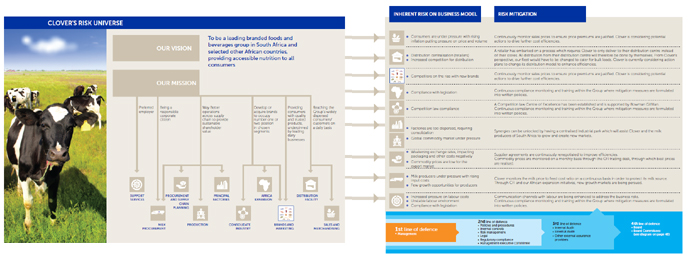
Clover’s Enterprise Wide Risk Management Framework was independently assessed by Internal Audit against the principles of the King III Code as part of Clover’s three year rolling plan. The report issued by Deloitte based on the Corporate Governance Review performed noted that the Group has implemented strong governance structures and have adopted and implemented various leading risk management practices, policies and processes. A mature risk management approach has been implemented with regards to the assessment, monitoring and reporting of strategic risks and opportunities which are aligned to the Group’s vision and mission.
Clover runs ongoing fraud awareness campaigns at branch level across all levels of staff in order to raise awareness of the Group’s Ethics Policy, the use of the Ethics Hotline and the fact that all calls to this line are treated confidentially by an independent party. Tip-offs received are actively investigated, followed-up on and resolved. The Board assisted by the Audit and Risk Committee, is satisfied with the effectiveness of the risk management process.
Governance of information technology (IT)
At Clover, IT is an integral part of the business and fundamental in sustaining current operations. In view of the strategic importance of IT, Clover aligned business’ requirements from IT to available IT resources and available technology to ensure appropriate IT strategy is formulated to improve Clover’s competitiveness for its future sustainability. To implement the IT strategy, Clover IT has developed an IT Governance Framework that considers relevant structures and processes to enable IT to meet business requirements, while ensuring relevant best practises, such as included in the COBIT framework, have been adopted to ensure appropriate mitigation of IT risks. IT governance is a set of business processes that imposes management and control disciplines on IT activities to help ensure the integrity and protection of IT operations and the achievement of targeted business goals. This implies a system in which all stakeholders, including the Board, internal customers, and in particular departments such as finance, have the necessary input into the decision making process.
The Board is responsible for IT Governance, with IT included in the Board’s work plan. The Board delegated the responsibility to implement the IT Governance framework to management with oversight by the Audit and Risk Committee, whom quarterly consider priority IT risks and opportunities as reported in the Group’s Risk report. In the financial year ending June 2015, Deloitte’s has performed advisory reviews on Clover’s IT Governance against the COBIT framework, including requirements ensuring protection of personal information as well as adequacy of Clover’s IT disaster recovery procedures.
Clover successfully replaced its legacy order-to-cash system in August 2014 with a commercial off-the-shelf system used in international dairy companies called eRMS (Electronic Route Management System). In view of the complexity and the magnitude of the risks involved, Clover engaged with Ernst & Young Incorporated (“EY”), the Group’s External Auditors, to ensure that the programme governance process was independently assessed and advised on. More specifically, in terms of overall delivery, the risks with the programme governance and delivery management that expose the programme to risks were assessed and advised on.
In May 2015, EY performed a post migration review of the eRMS system and assessed the stabilisation of the eRMS system since go-live. During the migration, management performed reconciliations on Debtors and Inventory balances to verify the accuracy of the information migrated between source and target systems. These reconciliations were inspected and confirmed that they were reviewed and signed off with no material differences. System incidents, mostly related to user errors, logged after go-live reduced dramatically as users became more comfortable with the system through the stabilisation process. The system has reached stability and business has been operated “as usual” since February 2015, with no incidents reported that have resulted in business disruption owing to system errors.
Compliance with laws, codes, ru les and standards
The responsibility of facilitating compliance throughout the Company has been delegated to the Company Secretary.
Clover ensures that all employees are inducted and are made consistently aware of the Group’s compliance policies and procedures. Clover is in the process of finalising its compliance policy and manual which documents how applicable laws, regulations and supervisory requirements should be complied with. Non-adherence to the documented standards will lead to disciplinary action which could result in dismissal.
After consultation with business and by adopting the risk rating methodology, the following Acts and supervisory requirements, in no particular order, have been identified as priority areas:
| 1 | Agricultural Products Standards Act 119 of 1990 |
| 2 | Companies Act 71 of 2008 |
| 3 | Competition Act 89 of 1998 |
| 4 | Consumer Protection Act 68 of 1998 |
| 5 | Employment Equity Amendment Act 47 of 2013 |
| 6 | Foodstuffs, Cosmetics and Disinfectants Act 4 of 1972 read together with the Regulations |
| 7 | Income tax Act 58 of 1962 |
| 8 | JSE Listings Requirements |
| 9 | Labour Relations Amendment Act 6 of 2014 |
| 10 | National Building Regulations and Building Standards Act 103 of 1977 (as amended) |
| 11 | Occupational Health and Safety Act 85 of 1993 read together with the Regulations |
| 12 | Tax Administration Act 28 of 2011 |
| 13 | Value-Added Tax Act 89 of 1991 |
During the year under review, Clover continues to
consult with business in order to enhance its regulatory
universe and its documented process to ensure
adequate and effective controls. Clover’s Regulatory
Universe consists of more than 80 legislated and non-legislated
supervisory requirements that are applicable
to the business.
Compliance with provisions of the Consumer Protection Act and Competition Act
Clover trains its staff and promotes a culture of compliance through educational online training campaigns which raise awareness and understanding of the requirements and obligations of the Competition Act as well as the Consumer Protection Act. It is compulsory for all employees in management roles and those who may be exposed to anti-competitive or collusive behaviour by nature of their position within the Group, to complete the training.
During the review period, more than 690 employees completed the online training and refresher valuations (2014: 686 employees). As referred to previously, Clover established a Competition Law Centre of Excellence (“CLCE”) in conjunction with the KPMG Competition Law Advisory Practice in 2012, however, Clover has during the year under review replaced the KPMG Competition Law Advisory Practice with Bowman Gilfillan as its Competition Law advisors. The CLCE functions as a critical tool to ensure high standards of competition law compliance within Clover. Apart from various legal proceedings in the ordinary course of business, the Board is satisfied that there are no material pending or threatening legal actions.
During the year under review Bowman Gilfillan commenced with a full review of Clover’s compliance with the Competition Act with a particular focus on areas of milk procurement, commercial arrangements and joint ventures.
On 13 March 2014 the Acting Commissioner of the Competition Commission initiated a complaint against Clover Industries Ltd (“Clover”), Parmalat (Pty) Ltd (“Parmalat”) and Midlands Milk (Pty) Ltd (“Midlands Milk”) alleging that Clover Industries Ltd, Parmalat (Pty) Ltd and Midlands Milk (Pty) Ltd agreed, at some stage in or around 2012, to fix the purchase price of raw milk or trading conditions in terms of which the raw milk is purchased, in possible contravention of section 4(1) (b)(i) of the Competition Act 89 of 1998, as amended. The said complaint only came to Clover’s attention during March 2015 and Clover immediately conducted an internal investigation in conjunction with Bowman Gilfillan. The investigation of Bowman Gilfillan has not revealed any conduct on Clover’s part that suggests that in 2012 it directly or indirectly co-ordinated with Parmalat and Midlands Milk to fix the purchase price of raw milk or trading conditions in terms of which the raw milk is purchased as alleged by the Commission.
In early 2015, Clover and Danone Southern Africa (Pty) Ltd agreed to refer certain contractual disputes to arbitration in accordance with the terms and conditions of the Secondary Distribution Agreement and Manufacturing and Packaging Agreement respectively. The matter was settled between the parties.
During the review period, Clover complied in all material aspects with all relevant legislation.
Insider trading
The Board adopted Clover’s Group Price-Sensitive Information Policy and Group Insider Trading Policy. Compliance with these policies provides reasonable assurance that directors, officers, relevant employees and service suppliers of the Group and its subsidiaries are aware of and comply with the policies’ requirements.
Salient features of these policies are:
- no employee of the Group may deal directly or indirectly in Clover’s shares on the basis of unpublished price-sensitive information regarding the business;
- no director or officer of the business may disclose trade information of the business; and
- directors and officers are precluded from trading in Clover shares during closed periods or prohibited periods as determined by the Board.
Closed periods are imposed from:
- the end of the first six-month period to the time of the publication of the interim financial results on the JSE’s Securities Exchange News Service (“SENS”); and
- the financial year-end date to the time of the publication of the final financial results on the JSE’s SENS.
Any director wishing to trade in Clover’s shares must obtain clearance from the Chairman of the Board or the designated director prior to trading in these shares.
Internal audit
Clover has outsourced its Internal Audit function to Deloitte who are responsible for implementing the annual internal audit plan approved by Clover’s Audit and Risk Committee. As with any policy or protocol, there are inherent limitations to the effectiveness of any system of internal control due to human error or the deliberate circumvention or overriding of controls. Accordingly, an effective internal control system can provide only reasonable assurance with regards to financial statement preparation and safeguarding of assets. Clover’s internal controls and systems are designed and monitored to provide reasonable assurance regarding the reliability of the financial statements and to protect, verify and maintain accountability for its assets. These controls are based on established policies and procedures, implemented by trained personnel with segregated duties and responsibilities. Internal control systems are managed by way of a documented organisational structure with segregation of responsibilities as well as established policies and procedures which are communicated throughout the Group. Incumbents are carefully selected, trained and developed to effectively execute their duties. Significant findings are reported to the Executive Committee as well as the Audit and Risk Committee, with corrective action measures implemented to address identified internal control deficiencies.
During the review period, no material breakdowns in internal controls were reported within the key areas reviewed. These evaluations were the main input considered by the Board in reporting on the effectiveness of internal controls.
In addition, the external auditors, Ernst & Young Incorporated performed a limited assurance review of management’s assessment of internal controls over financial reporting. This was in addition to the Internal Audit conducted by Deloitte. No material findings were reported to the Audit and Risk Committee and nothing has come to the Directors’ or the auditors’ attention that indicates any material breakdown in the effectiveness of the internal controls and systems during the reporting period.
Disclosure of compliance with the Code
As required by the JSE Listings Requirements, the Board endorses the King Code of Governance Principles for South Africa 2009 and has satisfied itself that the Group has conformed throughout the reporting period to all material aspects of the Code, except where it has applied the principle of “apply or explain” as indicated in the King III index.
Jacques van Heerden
Company Secretary
15 September 2015