

Remuneration Policy
Remuneration philosophy
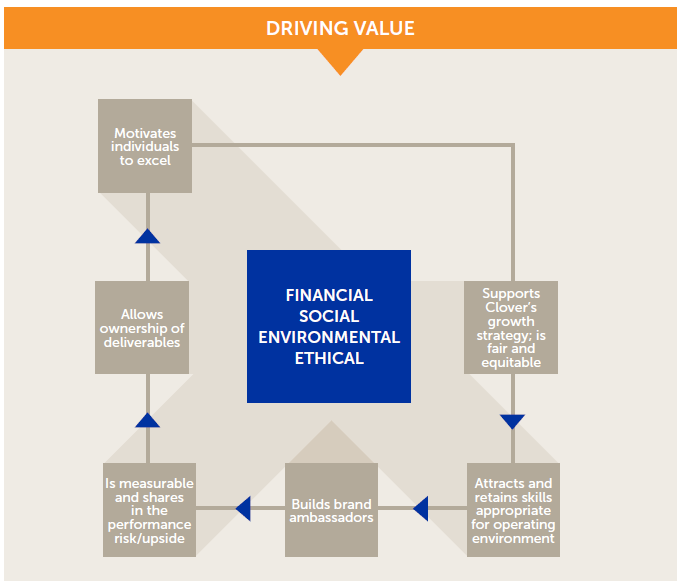
Clover’s Group Remuneration Policy is aimed at attracting and retaining key, specialist skills in order to assist in generating a return on investment for shareholders that is sustainable in the long term. In line with international best practice, the Remuneration Policy strives to attain its objective by establishing remuneration practices that are fair, reasonable and market related by combining short-term remuneration with longer-term incentives. The long-term interests of those who potentially administer the most significant influence on sustained growth, the executive and senior management, are aligned with the interests of shareholders.
Clover’s Remuneration Policy is based on the following key principles:
- remuneration should support the Group’s strategies and be consistent with the organisation’s culture of fairness and equity;
- remuneration should take into account the size of the Group, the complexity of the business and the competitive environment;
- remuneration should support the Group’s vision to be the most admired branded consumer goods company in South Africa and other emerging markets by attracting and retaining the appropriate talent;
- remuneration should directly correlate with the growth objectives, financial performance targets and actual achievements of the business of the Group;
- remuneration should be reviewed and benchmarked regularly through independent external professional service providers to ensure that the Group remains competitive in the diverse markets in which it operates, not applying percentiles rigidly but taking into account industry type, skills scarcity, performance, and legislative structures and requirements;
- remuneration should motivate and allow for differentiation (i.e. reward high performers); and
- individual contribution based on role and responsibilities should have a direct bearing on the levels of remuneration.
Clover’s Remuneration Policy
Governance
Clover’s Group Remuneration Committee is a subcommittee of the Board and oversees the approach to and governance of remuneration matters. It also determines the remuneration of Executive Directors, other executives as well as recommending the remuneration of Non-executive Directors, which is ultimately approved by shareholders. Details on Remuneration Committee members, meetings and attendance are set out in the Corporate Governance section of this Integrated Annual Report, here and here. The Remuneration Committee actively engages with independent advisors and stakeholders, to ensure that the remuneration policy and practices are aligned to best practice and achieving the objectives of the Group. The Executive Committee determines and approves the remuneration structures for all employees who are not executives in line with the existing remuneration mix set out below.
 Remuneration mix
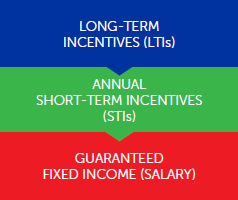
Clover’s remuneration structure comprises three components and are aligned with achieving Group objectives:
Remuneration mix: Guaranteed fixed income component
Guaranteed Fixed Income comprises:
- monthly salary;
- compulsory benefits (i.e. retirement); and
- discretionary benefits (i.e. medical aid).
Employees on Paterson Grade C3 and lower can choose to join Discovery Health Medical Scheme or Umvuzo Medical Scheme. Membership to a medical scheme is not compulsory. For Paterson Grade C4 and higher the Discovery Health Medical Scheme is compulsory.
Guaranteed Fixed Income considerations
- regular benchmarking exercises are performed internally and externally to ensure equity, fairness and market relatedness;
- the fixed income component is reviewed annually in May and is revised on 1 July of each year, following quarterly performance management reviews of each employee;
- interim reviews of the fixed income component are undertaken to retain talent, taking into account market adjustments or employee promotions;
- Clover’s employment profile is based on the competencies, outputs and behaviour required for a specific position; and
- the employment profile must fit within the organisational structure and an appropriate employment grade should be assigned to the position.
Scarce skills
Scarce skills are defined as a skill where market demand outstrips the available supply. Scarce skill sets are identified annually and the strategy is adjusted to reduce business risk. If scarcity is as a result of a unique combination of skills and experience, deliberate efforts are made to build a talent pool around the incumbent, to reduce business risk. Incumbents identified as having scarce skills are graded as “S”-band employees in terms of Clover’s employment scale. To reduce the risk of losing highly specialised skills, the fixed income component applied to this category is targeted at the top-end (90th percentile) of the market range and also includes a discretionary retention bonus (8% of annual basic salary) payable at the end of each financial year, provided that the necessary performance criteria are met. Clover has identified 26 employees who are graded as “S”-band employees. The executive committee annually reviews this category to ensure the above criteria is complied with.
Differentiation between Paterson Grades
| Paterson Grade | Guaranteed fixed income | Short-term incentive | Long-term incentive |
| B5 and below | Base pay and benefits: 13th cheque | N/A | N/A |
| C1 to C5 | Base pay and benefits: 13th cheque | Merit bonus based on formal performance management. Short-term incentive scheme for selected Paterson Grade C5 employees | N/A |
| D1 to D5 | Base pay and benefits | Short-term Incentive Scheme | Long-term Incentive Scheme for selected employees |
| E | Base pay and benefits | Short-term Incentive Scheme | Long-term Incentive Scheme |
| F | Base pay and benefits | Short-term Incentive Scheme | Share Appreciation Rights Scheme |
Remuneration mix: Annual short-term incentive component
Annual Short-Term Incentive Scheme (“STI”)
STIs are designed to drive improvement of the Group’s results on an annual basis.
| Paterson Band | Individual performance |
Group profit |
Individual performance cap |
Group profit cap |
Entitlement (months base salary**) |
Maximum entitlement (months base salary*) |
Profit target |
| D1–D2 | 75% | 25% | 100% | 200% | 2 | 2,5 | Operating profit |
| D3–D5 | 50% | 50% | 100% | 200% | 3 | 4,5 | Operating profit |
| E* | 50% | 50% | 100% | 200% | 5 | 7,5 | Operating profit |
| Other Executives***(F) | 40% | 60% | 100% | 183% | 10 | 15 | Normalised
attributable profit |
| Chief Executive(F) | 30% | 70% | 100% | 171% | 12 | 18 | Normalised
attributable profit |
| * | For example, if a staff member on the Paterson E band achieves a 100% individual performance bonus and a 200% Group profit bonus the employee will be able to earn 7,5 months’ additional base salary in bonuses. |
| ** | For Paterson Grades D1 to D5 the base salary consists of the employees’ monthly basic salary, for Paterson Grades E, the base salary consists of the employees’ monthly basic salary, plus 22% car allowance plus 10% pension fund contribution and for Paterson Grade F, the base salary consists of the employees’ total monthly guaranteed fixed income. |
| *** | Marcelo Palmeiro and Jacques van Heerden’s STI differ from what is stated above as it has been agreed to individually between them and the Company. |
STIs measures and targets
For Paterson Grade C:
- individuals who score an annual individual performance rating of 4 or 5 qualify for a merit bonus; and
- the merit bonus is calculated as a percentage of annual basic salary and is paid in August or September of each year.
For Paterson Grade E and D:
- the individual performance portion of the STI is based on specific key performance indicators agreed to between the employee and his/her direct manager;
- calculated on operating profit before restructuring costs;
- the profit target is triggered once 95% of target is reached; and
- a 1% additional bonus is paid for every 1% achieved over the profit target.
For Paterson Grade F (Executive):
- the individual performance portion of the STI is
based on specific key performance approved
by the Remuneration Committee annually and
includes, inter alia;
- leadership and team building;
- optimising the brand portfolio;
- increase market shares through sales and distribution strengths;
- successful completion of capital projects;
- mergers, acquisitions and rest of Africa
- Employment Equity;
- Investor Relations;
- calculated using normalised attributable profit; and
- the profit target is triggered once 90% of the profit target is reached. If the profit exceeds the target, an additional bonus of 3.55% for the CE and 4.15% for the CFO and other executives will be paid for every 1% achieved over the profit target.
STIs are self-funded since all bonuses are budgeted for in full before the profit target is approved by the Remuneration Committee annually. The final profit figure is confirmed by the Remuneration Committee and approved by the Board following completion of the annual audit and is not necessarily linked to the budget approved by the Board. Incentives are paid in August and/or September of each applicable year. The Remuneration Committee has the sole and absolute discretion to make adjustments for extraordinary factors, taking into account external factors beyond the control of employees, such as cyclicality. Employees who have been found guilty of gross misconduct will not be entitled to participation in STIs. Processes have been put in place to manage and guide employees to achieve the maximum bonus (and relevant profit targets) by means of quarterly performance management sessions on an individual basis.
Remuneration mix: Long-Term Incentive component
Long-Term Incentive Scheme (“LTI”)
Clover’s LTI is a deferred bonus scheme, serving as a retention mechanism. It awards employees on Paterson Grade E (and certain positions on grade D5) (senior management) for adding tangible value to the businesses of the Group.
LTI measures and targets:
- calculated using normalised attributable profit;
- a percentage of annual base salary; and
- paid out in equal amounts over a three-year period (with first tranche paid out 12 months after becoming entitled).
| Target achieved | Bonus payable |
| Normalised attributable profit target as per budget | 20% of annual base salary |
| Normalised attributable profit target as per budget plus 10% | 40% of annual base salary |
| Normalised attributable profit target as per budget plus 20% | 60% of annual base salary |
For Paterson Grade E, the base salary consists of the
employees’ monthly basic salary, plus 22% car allowance
plus 10% pension fund contribution. The LTI is governed
by rules which are regularly reviewed and updated by
the Executive Committee as necessary for alignment
with best practice.
Share Appreciation Rights Scheme (“SAR Scheme”) or (“SARs”)
The purpose of the SAR Scheme is to attract, retain, motivate and reward the Group’s Executives (Paterson Grade F) and/or other participants who are able to influence the performance of the Group, by aligning their interests with those of shareholders. The SAR
Scheme is governed according to rules approved by the Company’s shareholders in November 2010.
SARs measures and targets
The eligibility criteria, the quantum of allocations and the conditions governing each allocation are determined by the Remuneration Committee and take into account seniority within the Group, work function and the ability of the participant to add value to the Group and its businesses.
First time allocation of SARs
Except for the initial allocation (set out here and here in this Integrated Annual Report) the following market related formula is used to determine the number of share appreciation rights a participant may be eligible for when participating in SARs for the first time:
A = (B x C)/D
Where:
| A | The total number of SARs to be allocated | ||||||
| B | Guaranteed Fixed Income component of the participant | ||||||
| C | Market related multiple | ||||||
|
|||||||
| D | The volume weighted average price of an ordinary share listed on the JSE over seven trading days immediately prior to the allocation date. |
Subsequent SARs allocations (following
a participant’s first allocation)
Following a benchmarking exercise conducted by PricewaterhouseCoopers, the Remuneration Committee resolved with effect from 1 July 2012 that the smoothed average face value allocation formula (set out below) will be used when allocating subsequent SARs to a participant (following the first allocation):
A = (B x C)/D
Where:
| A | The total number of SARs to be allocated |
| B | Guaranteed Fixed Income component of the participant |
| C | Market-related multiples set out below |
| D | The volume weighted average price of an ordinary share listed on the JSE over seven trading days immediately prior to the allocation price |
| Participant | Annual smoothed face value multiple |
| CE | 267% |
| CFO | 200% |
| Other Executives | 167% |
Change of control provisions
If Clover is the subject of any transaction whereby any person or persons acting in concert, other than the Clover Milk Producers Trust and/or participants, acquire (whether directly or indirectly) 30% of the entire ordinary issued share capital in Clover, then the vesting of all SARs held by participants shall immediately vest and all SARs shall (whether or not the vesting dates in respect thereof have passed and/or the performance criteria, if any, in respect thereof have been met) be exercisable on the basis that participants shall on exercise be settled in accordance with the SARs Plan.
In respect of any SARs allocated to participants on or after 1 January 2014, if 30% of the entire issued share capital of Clover is acquired by any person or persons acting in concert (other than the Clover Milk Producers Trust and/ or the participants), not all of the SARs shall immediately vest in participants but only the proportionate number thereof, having regards to (i) the period of time that has lapsed between the allocation date and the vesting date at the time of the acquisition (whether directly or indirectly) and (ii) the extent to which the performance criteria (if any) have been satisfied as at the date of the acquisition, as may be determined by the Remco to be fair and reasonable to the participants concerned, provided that should a dispute arise between the participants and the Remuneration Committee such dispute shall be referred to the Board for determination, provided that should such dispute not be resolved within a period of 60 (sixty) days from such referral to the Board the dispute shall be referred to the expert in terms of section 15 of the SARs Plan for final determination.
Period of vesting of SARs
The SAR Scheme rules provide that all SARs allocated (unless it is a first allocation) on or after 1 July 2011:
- will vest in full after the third anniversary of the allocation date, provided that the relevant performance criteria were met; and
- which have vested must be exercised by the participant on or before the seventh anniversary of the relevant allocation date relating to such allocation of SARs.
SARs performance criteria
All SARs allocated on 1 July 2012 will be subject to the following performance criteria:
Individual performance condition
- 25% will be subject to personal performance conditions to be set and measured by the Chief Executive for each of the participants, provided that the Chief Executive will make a recommendation regarding the vesting of the 25% of the allocation to the Remuneration Committee for each of the participants.
Financial performance conditions
- 75% will be subject to achieving specific financial performance measures;
- headline earnings per share must exceed the previous four years’ headline earnings per share plus the average inflation rate over the previous four years plus 2% growth; and
- the vesting of the 75% portion of the allocation will be based on a sliding scale whereby 30% of the allocation will vest when headline earnings per share growth equal to the average inflation rate is achieved and 100% will vest if headline earnings per share is increased by a minimum of 2% above inflation.
All SARs allocated on 1 July 2013 will be subject to the following performance criteria:
Individual performance condition
25% will be subject to personal performance conditions to be set and measured by the Chief Executive for each of the participants, provided that the Chief Executive will make a recommendation regarding the vesting of the 25% of the allocation to the Remuneration Committee for each of the participants.
 Financial performance condition
- 75% will be subject to achieving specific financial performance measures;
- headline earnings per share for the year (in which the vesting is supposed to take place) must exceed the previous year’s headline earnings per share plus the annual inflation rate (for the period 1 July to 30 June) plus 2% growth; and
- the vesting of the 75% portion of the SARs allocation will be based on a sliding scale whereby 30% of the allocation will vest when headline earnings per share equal to the annual inflation rate is achieved and 100% of the allocation will vest if headline earnings per share is increased by a minimum of 2% above the annual inflation rate.
Following Clover’s engagement with significant shareholders during the 2014 financial year and the subsequent benchmarking exercise conducted by PricewaterhouseCoopers, the Remuneration Committee adjusted the performance measurements to include additional financial measures, in particular return on equity (ROE), as qualifying criteria. All SARs allocated on or after 30 June 2014 will be subject to the following performance criteria:
Individual performance condition
30% of the allocation to be subject to the achievement of individual performance, measured as the average over three years. 30% vests at 70% performance and 100% vests at 90% performance as follows:
| Performance | Weighting | Targets |
| Individual performance condition |
30% | Average individual performance measured over 3 years. 30% vests at 70% performance; and 100% vests at 90% performance. |
Financial performance conditions
70% of the SARs allocation will be subject to financial performance:
- headline earnings per share constituting 50%; and
- ROE constituting 20%.
The HEPS performance condition targets will be as follows:
| Performance | Weighting | Targets |
| Financial performance condition HEPS |
50% | Threshold: 30% will vest if HEPS growth (over the performance period of 3 years) of CPI per annum is achieved; Target: 65% will vest if HEPS growth (over the performance of 3 years) of CPI +2% per annum is achieved; and Stretch: 100% will vest if HEPS growth (over the performance period of 3 years) of CPI +4% per annum is achieved. |
In line with other conditions of performance, 3 ROE targets will be set:
- the threshold target, where 30% (of the remaining 20%) of the SARs allocation will vest;
- the target, at which 65% (of the remaining 20%) of the SARs allocation will vest; and
- the stretch target, at which 100% (of the remaining 20%) of the SARs allocation will vest.
The ROE targets will be as follows:
| Performance | Weighting | Targets |
| Financial performance condition ROE |
20% | Threshold: 30% will vest if actual ROE achieved in the base year*; Target: 65% will vest if actual ROE achieved in the base year* + 0,4%; and Stretch: 100% will vest if actual ROE achieved in the base year* + 0,9%. |
| * | Base year = year in which allocation is made. |
ROE targets will include projects and in the event of material changes to the nature, scope or implementation of
planned projects, the Remuneration Committee or the Board may adjust the ROE targets.
APPROACH TO EXECUTIVE REMUNERATION
In order to attract, retain, motivate and incentivise the industry’s best and most suitable candidates, the Group acknowledges that it is obliged to offer competitive remuneration packages. The Remuneration Committee utilises external market surveys and benchmarks in order to determine Executive remuneration and benefits as well as the base and attendance fees for Non-executive Directors. Clover’s remuneration philosophy seeks to align and link both short- and long-term incentives to the achievement of business objectives and the delivery of an acceptable return on shareholders’ equity whilst ensuring the sustainability of the Company. Remuneration packages are therefore linked to the achievement of these objectives.
Executive remuneration structures (including those of Executive Directors) comprise both guaranteed and variable components as set out and explained below:
| Component | Type | Comprises | Objective |
| Guaranteed | Guaranteed Fixed Income |
Base salary, benefits (car allowance, retirement and medical aid contributions). |
Commensurate with scope of position, experience and level of responsibility. |
| Variable | Short-term incentive | Cash-based payments to an individual based on Group financial performance and individual performances over the preceding financial year. |
Rewards individual and corporate performance. Eligible staff are those on Paterson band C1 to F. Refer to STI table (to be inserted) |
| Variable | Long-term incentive | All cash and equity based awards that accrue to and individual over time, based on the Group’s financial and individual performance over a financial period. |
Attract, retain and incentivise key incumbents to deliver exceptional individual and corporate performance over time, in line with shareholder interests. |
Guaranteed Fixed Income
Executive guaranteed fixed income packages are benchmarked regularly using market data for individual salary levels for similar positions in the market place. This information, together with individual performance assessments, form the base for annual salary reviews.
The Remuneration Committee has the requisite discretion to determine Executive guaranteed fixed income packages and is mindful of factors such as retention, contribution and skill levels. Executives are able to participate in a defined contribution retirement fund and other benefits include vehicle allowances, medical insurance, death and disability insurance, leave and recognition for service.
Variable package
Short-term Incentives (“STIs”)
Executives’ participation in STIs are linked to the achievement of profit growth targets and personal performance measures. The complete workings of the STIs are set out in the Remuneration Policy on here more specifically the table set out here.
Long-term Incentives (“LTIs”)
Clover’s LTIs relating to its executives consist of equity based awards and serve as a retention mechanism. Refer to the Remuneration Policy here in this report for more information on the salient features of the cash and equity measures and targets, in particular the Share Appreciation Rights Scheme, which complies with the JSE Listings Requirements.
Under the SAR Scheme, the aggregate number of ordinary shares which may be acquired by the Executives may not exceed 16 million ordinary shares. At 30 June 2015, a total of 8 619 271 (30 June 2014: 3 366 822 ordinary shares) have been issued to Executives, with the balance of 7 380 729 ordinary shares remaining available for issue. The salient features of the SAR Scheme, which complies with the JSE Listings Requirements, are set out in the Remuneration Policy, which can be found on here in this Integrated Annual Report.
Allocations made in terms of the SAR Scheme
The First and Second Allocations were legacy scheme issues in terms of the Management Participated Capital Restructuring Exercise (“MPCRE”) and are disclosed separately at the back of this report. For more detail on SARs exercised during the year, refer to note 32.2 in the financial statements section.
| Number of SARs allocated |
Allocation date |
Allocation price |
Total # SARs vested as at 30 June 2015 |
Total # SARs exercised by 30 June 2015 |
Total # SARs vested but not yet exercised as at 30 June 2015 |
Total # ordinary shares issued to settle SARs exercised by 30 June 2015 |
|
| Third allocation Executive Directors |
|||||||
| JH Vorster | 821 256 | 1 July 2011 | R11,00 | 821 256 | 330 723 | Nil | 365 923 |
| LJ Botha | 404 063 | 1 July 2011 | R11,00 | 404 063 | 404 063 | Nil | 180 036 |
| CP Lerm | 1 119 | 1 July 2011 | R11,00 | 1 119 | 1 119 | Nil | 499 |
| Other Executives | |||||||
| H Lubbe | 57 778 | 1 July 2011 | R11,00 | 57 778 | Nil | 57 778 | Nil |
| JHF Botes | 330 723 | 1 July 2011 | R11,00 | 330 723 | 330 723 | Nil | 147 358 |
(a) Vesting
The SARs allocated as part of the Third Allocation vested on 30 June 2014.
(b) Performance criteria
The following performance criteria has to be met prior to the vesting of the SARs relating to the Third Allocation:
- over a four-year cycle the total normalised attributable profit must exceed that of the previous four-year cycle.
(c) General
In the event that these performance criteria are not met prior to the vesting of the SARs, the portion of allocated SARs eligible for vesting will be forfeited. In addition, all SARs allocated as part of the Third Allocation and all subsequent allocations which have vested, must be exercised by the Executive on or before the seventh anniversary of the relevant allocation date relating to such allocation of SARs.
(a) Vesting
The SARs allocated as part of the Fourth Allocation vested on 30 June 2015.
(b) Performance criteria
As set out in the Remuneration Report here in this Integrated Annual Report.
(c) General
In the event that the above performance criteria are not met prior to the vesting of the SARs, the portion of allocated SARs eligible for vesting will be forfeited. In addition, all SARs allocated relating to the Fourth Allocation and all subsequent allocations, which have vested must be exercised by the Executive on or before the seventh anniversary of the relevant allocation date relating to such allocation of SARs.
Salient features of the Fourth Allocation
| Number of SARs allocated |
Allocation date |
Allocation price |
Total # SARs vested as at 30 June 2015 |
Total # SARs vested but not yet exercised as at 30 June 2015 |
Total # SARs exercised by 30 June 2015 |
|
| Fourth allocation Executive Directors |
||||||
| JH Vorster | 1 036 716 | 1 July 2012 | R13,73 | 1 036 716 | 1 036 716 | Nil |
| LJ Botha | 533 657 | 1 July 2012 | R13,73 | 533 657 | 533 657 | Nil |
| CP Lerm | 389 123 | 1 July 2012 | R13,73 | 389 123 | 389 123 | Nil |
| Other Executives | ||||||
| H Lubbe | 389 123 | 1 July 2012 | R13,73 | 389 123 | 389 123 | Nil |
| JHF Botes | 389 123 | 1 July 2012 | R13,73 | 389 123 | 389 123 | Nil |
| ER Bosch | 389 123 | 1 July 2012 | R13,73 | 389 123 | 389 123 | Nil |
Salient features of the Fifth Allocation
| Number of SARs allocated |
Allocation date |
Allocation price |
Total # SARs vested as at 30 June 2015 |
Total # SARs exercised by 30 June 2015 |
|
| Fifth allocation Executive Directors |
|||||
| JH Vorster | 879 589 | 1 July 2013 | R16,83 | Nil | Nil |
| LJ Botha | 452 775 | 1 July 2013 | R16,83 | Nil | Nil |
| CP Lerm | 332 135 | 1 July 2013 | R16,83 | Nil | Nil |
| Other Executives | |||||
| H Lubbe | 332 135 | 1 July 2013 | R16,83 | Nil | Nil |
| JHF Botes | 332 135 | 1 July 2013 | R16,83 | Nil | Nil |
| ER Bosch | 332 135 | 1 July 2013 | R16,83 | Nil | Nil |
| MM Palmeiro | 380 159 | 1 July 2013 | R16,83 | Nil | Nil |
(a) Vesting
The SARs allocated as part of the Fifth Allocation vested on 30 June 2013.
(b) Performance criteria
As set out in the Remuneration Report here in this Integrated Annual Report.
(c) General
In the event that the above performance criteria are not met prior to the vesting of the SARs, the portion of allocated SARs eligible for vesting will be forfeited. In addition, all SARs allocated relating to the Fifth Allocation and all subsequent allocations, which have vested must be exercised by the Executive on or before the seventh anniversary of the relevant allocation date relating to such allocation of SARs.
Salient features of the Sixth Allocation
| Number of SARs allocated |
Allocation date |
Allocation price |
Total # SARs vested as at 30 June 2015 |
Total # SARs exercised by 30 June 2015 |
|
| Sixth allocation Executive Directors |
|||||
| JH Vorster | 906 510 | 30 June 2014 | R17,31 | Nil | Nil |
| LJ Botha | 466 633 | 30 June 2014 | R17,31 | Nil | Nil |
| CP Lerm | 342 300 | 30 June 2014 | R17,31 | Nil | Nil |
| Other Executives | |||||
| H Lubbe | 342 301 | 30 June 2014 | R17,31 | Nil | Nil |
| JHF Botes | 342 301 | 30 June 2014 | R17,31 | Nil | Nil |
| ER Bosch | 342 301 | 30 June 2014 | R17,31 | Nil | Nil |
| MM Palmeiro | 391 795 | 30 June 2014 | R17,31 | Nil | Nil |
(a) Vesting
The SARs allocated as part of the Sixth Allocation will vest in full after the expiry of three years from 30 June 2014. The Remuneration Committee has resolved that all SARs will in future be allocated on 30 June of each year to enable the executives or other participants to accept the allocation prior to the commencement of the company’s closed period relating to its financial year end which commences on 30 June.
(b) Performance criteria
As set out in the Remuneration Report here in this Integrated Annual Report.
(c) General
In the event that the above performance criteria are not met prior to the vesting of the SARs, the portion of allocated SARs eligible for vesting will be forfeited. In addition, all SARs allocated relating to the Sixth Allocation and all subsequent allocations, which have vested must be exercised by the Executive on or before the seventh anniversary of the relevant allocation date relating to such allocation of SARs.
Salient features of the Seventh Allocation
| Number of SARs allocated |
Allocation date |
Allocation price |
Total # SARs vested as at 30 June 2015 |
Total # SARs exercised by 30 June 2015 |
|
| Seventh allocation Executive Directors |
|||||
| JH Vorster | 975 927 | 30 June 2015 | R17,34 | Nil | Nil |
| LJ Botha | 505 334 | 30 June 2015 | R17,34 | Nil | Nil |
| CP Lerm | 371 109 | 30 June 2015 | R17,34 | Nil | Nil |
| Other Executives | |||||
| H Lubbe | 370 992 | 30 June 2015 | R17,34 | Nil | Nil |
| JHF Botes | 372 023 | 30 June 2015 | R17,34 | Nil | Nil |
| ER Bosch | 371 988 | 30 June 2015 | R17,34 | Nil | Nil |
| MM Palmeiro | 417 246 | 30 June 2015 | R17,34 | ||
| J van Heerden | 271 593 | 30 June 2015 | R17,34 | Nil | Nil |
(a) Vesting
The SARs allocated as part of the Seventh Allocation will vest in full after the expiry of three years from 30 June 2015. The Remuneration Committee has resolved that all SARs will in future be allocated on 30 June of each year to enable the executives or other participants to accept the allocation prior to the commencement of the company’s closed period relating to its financial year end which commences on 30 June.
(b) Performance criteria
As set out in the Remuneration Report here of this Integrated Annual Report.
 (c) General
In the event that the above performance criteria are not met prior to the vesting of the SARs, the portion of allocated SARs eligible for vesting will be forfeited. In addition, all SARs allocated relating to the Seventh Allocation and all subsequent allocations, which have vested must be exercised by the Executive on or before the seventh anniversary of the relevant allocation date relating to such allocation of SARs.
Salient features on the Allocation to newly appointed executives
Allocations were made to ER Bosch, MM Palmeiro and J van Heerden who were appointed by the Group as Executives with effect from 1 June 2012, 1 October 2012 and 18 September 2014 respectively.
| Number of SARs allocated |
Allocation date |
Allocation price |
Total # SARs vested as at 30 June 2015 |
Total # SARs exercised by 30 June 2015 |
|
| Executive Directors | |||||
| ER Bosch | 953 620 | 1 June 2012 | R13,50 | 317 873 | Nil |
| MM Palmeiro | 925 500 | 1 October 2012 | R14,15 | Nil | Nil |
| J van Heerden | 501 425 | 26 September 2014 | R17,55 | Nil | Nil |
(a) Vesting
The SARs allocated as part of this allocation will vest in three equal tranches on the expiry of three, four and five years from 1 June 2012, 1 October 2012 and 18 September 2014 respectively.
(b) Performance criteria
No performance criteria have to be met prior to the vesting of the SARs relating to this allocation as these allocations are made to retain executives.
(c) General
The primary purpose of the allocations to ER Bosch, MM Palmeiro and J van Heerden is to serve as a retention mechanism, therefore no performance criteria have to be met prior to the vesting date.
 Hedging of SARs
The Group has entered into a forward contract to purchase 2 132 695 Clover Industries shares to hedge a portion of the share appreciation rights issued to management. Refer to note 14 of the annual financial statements here for further details.
Employment contracts for ExecutivesThe notice period for termination of the contract of employment of Executives is six months.
Approach to Non-executive Directors’ remunerationIt is the Group’s policy to identify, attract and retain Nonexecutive Directors who can add value to Clover. For this reason, Non-executive fees are competitive and in the upper quartile.
Attendance fees are only paid for actual committee meetings attended.
The Chairman of the Board, Werner Büchner, and the Lead Independent Director, Tom Wixley will not receive additional remuneration should they serve on any sub-committee of the Board, since they receive a fixed annual fee. The fees payable to Non-executive Directors for the 2015 financial year will be proposed for consideration and approval at the 2015 Annual General Meeting to be held on 27 November 2015.
Total remuneration and benefits payable to Directors and prescribed officers.
The Board considered the requirements of the Companies Act with regard to the disclosure of the remuneration of Directors and prescribed officers. After careful consideration it was concluded that all members of the Executive Committee are deemed to be prescribed officers.
A complete table setting out the total remuneration of directors and prescribed officers can be found in note 32 to the annual financial statements here in this Integrated Annual Report.
Interest of Directors and other Executives of the Company in ordinary share capital.
A complete table setting out the interest of Directors and prescribed officers of the Company in the ordinary share capital can be found here to the Annual Financial Statements here in this Integrated Report.
LEGACY SCHEME SARs ISSUES
Salient features of the Initial Allocation
Clover’s Management Participated Capital Restructuring Exercise (MPCRE) which was approved by shareholders on 31 May 2010, changed the nature of the Group’s preference shares from profit-sharing instruments to pure debt instruments carrying rights to a guaranteed dividend only. This impacted on the value of the preference shares by eliminating any value upside. Consequently, an award of preference shares to Clover’s employees in terms of its preference share incentive scheme no longer incentivised employees or aligned their interests with those of ordinary shareholders. As a result, shareholders approved the adoption of the Clover Share Appreciation Rights Plan (2010) (SAR Scheme) on 31 May 2010. The SAR Scheme was subsequently amended on 4 November 2010 and 10 November 2011.
| Number of SARs allocated** |
Allocation date |
Allocation price |
Total # SARs vested as at 30 June 2015 |
Total # SARs exercised by 30 June 2015 |
Total # SARs vested but not yet exercised as at 30 June 2015 |
Total # ordinary shares issued to settle SARs exercised by 30 June 2015 |
|
| Executive Directors | |||||||
| JH Vorster | 4 587 200 | 31 May 2010 | R4,67 | 4 587 200 | 3 058 133 | 1 529 067 | 2 338 300 |
| LJ Botha | 2 443 140 | 31 May 2010 | R4,67 | 2 443 140 | 1 628 760 | 814 380 | 1 245 377 |
| CP Lerm | 2 454 758 | 31 May 2010 | R4,67 | 2 454 758 | 1 636 505 | 818 253 | 1 236 113 |
| Other Executives | |||||||
| H Lubbe | 2 027 236 | 31 May 2010 | R4,67 | 2 027 236 | 675 745 | 1 351 482 | 504 144 |
| JHF Botes* | 1 370 904 | 31 May 2010 | R4,67 | 1 370 904 | 913 936 | 456 968 | 690 329 |
| * | The Board recommended to shareholders that 500 000 ordinary shares be issued at a subscription of R4.67 to Dr. JHF Botes in exchange for which 500 000 SARs will be cancelled. Shareholders approved the aforementioned issue of ordinary shares to Dr. JHF Botes on 4 November 2010 and the 500 000 SARs were cancelled accordingly. |
| ** | As a result of the subdivision of the ordinary shares on a two-for-one basis during the listing process, the number of SARs allocated were doubled accordingly. |
Salient features of the Second Allocation
The Second Allocation was made in lieu of bonuses payable to the Executives relating to the disposal of Clover’s 45% shareholding in Danone Clover (Proprietary) Limited.
| Number of SARs allocated* |
Allocation date |
Allocation price |
Total # SARs vested as at 30 June 2015 |
Total # SARs exercised by 30 June 2015 |
|
| Executive Directors | |||||
| JH Vorster | 800 000 | 18 August 2010 | R0,00 | 800 000 | 800 000 |
| LJ Botha | 400 000 | 18 August 2010 | R0,00 | 400 000 | 400 000 |
| CP Lerm (Dr.) | 133 336 | 18 August 2010 | R0,00 | 133 336 | 133 336 |
| Other Executives | |||||
| H Lubbe | 133 332 | 18 August 2010 | R0,00 | 133 332 | 133 332 |
| JHF Botes (Dr.) | 133 332 | 18 August 2010 | R0,00 | 133 332 | 133 332 |
| * | As a result of the subdivision of the ordinary shares on a two-for-one basis during the listing process, the number of SARs allocated were doubled accordingly. |
(a) Vesting
The SARs allocated as part of the Second Allocation will vest in three equal tranches on the expiry of one, two and three years from 18 August 2010.
(b) Performance criteria
No performance criteria have to be met prior to the vesting of the SARs to the Second Allocation.
(c) General
Certain of the Executives exercised the SARs that vested on 18 August 2011 and 18 August 2012 in relation to the Second Allocation. The Group Remuneration Committee decided that all SARs exercised to date with regard to the Second Allocation will be settled in cash.
(a) Vesting
The SARs allocated as part of the Initial Allocation will vest in three equal tranches on the expiry of three, four and five years from 31 May 2010.
(b) Performance criteria
In terms of the Initial Allocation, no performance criteria have to be met prior to the vesting of the SARs.
(c) General
The SARs relating to the Initial Allocation were allocated to Executives as part of the MPCRE of the Group and in accordance with the SAR Scheme. The Initial Allocation will not be taken into consideration when determining future SARs allocations to Executives.
Loans to Executives
As part of the MPCRE (described in more detail under Legacy Scheme Issues) on 31 May 2010 (and on 4 November 2010 with regard to Dr. JHF Botes), respectively, the Executives subscribed and shareholders of the Company approved the allotment and issue to the Executives of 9 350 000 (on 31 May 2010) and 250 000 (on 4 November 2010 with regard to Dr. JHF Botes) ordinary shares at a subscription price of R9,34 per share, with a portion of the subscription price being lent to the Executives. However, the aforementioned allotment and issue sets out the position prior to the subdivision of shares approved on 4 November 2010. Full details relating to the MPCRE are available on www.clover.co.za.
The salient features of the loan and cession agreements entered into between the executives and the Company are set out below:
- as security for the indebtedness, the Executives have ceded to the Company the rights (defined as being all rights, title and interest in and to the proceeds) in respect of the ordinary shares (issued to them as referred to above) and the preference shares acquired through the Clover preference shares scheme in respect of the proceeds thereof (defined as being dividends, special distributions, redemption proceeds and any proceeds as a result of a disposal or sale of either the ordinary and/or preference shares referred to above, or any part thereof);
- interest shall accrue on the outstanding balance of the loan amount at an interest rate equal to 90% of the prevailing prime interest rate charged by Absa Bank Limited;
- if an Executive leaves the employ of the Company for any reason whatsoever, he/she shall be obliged to repay the loan amount and interest or the balance thereof, within two months after termination of his employment; and
- if an Executive dies, the loan amount and interest or the balance thereof, shall be repaid to the Company within six months after his/her death.
It should be noted that the aforementioned loan agreements have been amended to make provision for a final repayment date of the respective loans linked to the normal retirement date for each of the Executives.
| 30 June 2011 | 30 June 2012 | 30 June 2013 | 30 June 2014 | 30 June 2015 | |
| Executive Directors | |||||
| JH Vorster | 25 509 496 | 25 822 256 | 25 537 461 | 14 238 292 | 13 019 025 |
| Other Executives | |||||
| JHF Botes | 2 411 574 | 2 452 661 | 2 536 148 | 2 572 487 | 2 625 130 |
| Total | 27 921 070 | 28 274 917 | 28 073 609 | 16 810 779 | 15 644 155 |
The value of the ordinary shares forming the basis of the
loan and cession agreements referred to previously are
well in excess of R140 million.
Dr Steve Booysen
Chairman Remuneration Committee
15 September 2015